Do Ceiling Fans Actually Lower Your Cooling Bills in Summer
Summer heat in New Hampshire pushes air conditioners to run harder, and your electric bill climbs right along with the temperature. Many homeowners ask if a ceiling fan can take some of that load off the AC and shrink the monthly cost. The short answer is yes, but only when you understand how a ceiling fan actually works. A ceiling fan does not lower the temperature of a room the way an air conditioner does; it moves air across your skin and creates a wind chill effect that makes you feel cooler. That feeling lets you raise the thermostat by several degrees without losing comfort, and a higher thermostat setting is where the real savings come from. When you pair a properly installed ceiling fan with smart thermostat habits, you can trim cooling costs across the long Laconia summer. The savings depend on fan placement, blade direction, motor quality, and how consistently you use the fan. Done right, a ceiling fan becomes one of the cheapest cooling tools in your home.
How Ceiling Fans Lower Your Cooling Bills in Summer
A ceiling fan saves money by changing how warm a room feels rather than how warm it truly is. The spinning blades push a steady column of air downward, and that moving air pulls heat and moisture off your skin through evaporation. Your body reads that as relief, so you stay comfortable at a higher indoor temperature. The U.S. Department of Energy notes that running a ceiling fan lets you raise your thermostat about four degrees with no drop in comfort. Every degree you push the thermostat up reduces how often the compressor cycles on, and the compressor is the single biggest energy user in your cooling system. That is the mechanism behind the savings, and it works best when fans and AC operate together as a team. If you want your home wired to handle modern cooling demands, our air conditioning wiring service can make sure your system runs safely and efficiently.
How Ceiling Fans Lower Cooling Bills Through Wind Chill
The wind chill effect is the heart of how a ceiling fan saves you money during a hot New Hampshire summer. When air sits perfectly still in a room, a thin layer of warm, humid air clings to your skin and traps body heat against you. A ceiling fan breaks up that stagnant layer and replaces it with cooler, drier air from across the room. As that moving air sweeps past you, it speeds up the evaporation of moisture on your skin, and evaporation is a natural cooling process that pulls heat away from your body. The result is a comfort boost that can feel like the room dropped four or five degrees even though the thermometer has not moved at all. This is exactly why you can nudge the thermostat higher and still feel relaxed on the couch. Because the air conditioner runs less often, your compressor and blower motor draw far less power over the course of a day. Over an entire cooling season, those reduced run times add up to real dollars saved on every monthly statement.
It helps to understand that the wind chill effect only cools people, not empty rooms, so the fan does its job only when someone is there to feel it. The blades do not remove heat from the air or lower the actual room temperature in any measurable way. That distinction matters because it explains why a fan left running in an empty bedroom wastes electricity instead of saving it. The motor keeps spinning and pulling power, yet no one is present to benefit from the moving air. Smart fan use means treating the fan like a light switch tied to occupancy, on when you walk in and off when you leave. This single habit separates homeowners who save money from those who quietly add to their bill. A correctly sized fan with an efficient motor sips a tiny amount of electricity compared to the compressor it helps you avoid running.
Blade speed and room size both shape how strong the wind chill effect feels in any given space. A small fan struggling to cover a large open living area will move too little air to make a meaningful difference in comfort. A fan that is correctly matched to the square footage of the room delivers steady airflow that reaches the seating areas where people actually spend time. Higher blade speeds push more air and create a stronger cooling sensation, though most people find a medium setting comfortable for everyday use. Mounting height also plays a role, since a fan installed too close to the ceiling cannot circulate air the way a properly hung fan can. Getting all of these factors right is part of why professional installation pays off in real comfort and savings. A licensed electrician sizes the fan to the room and mounts it at the ideal height for maximum air movement.
How Ceiling Fans Lower Cooling Bills by Reducing AC Runtime
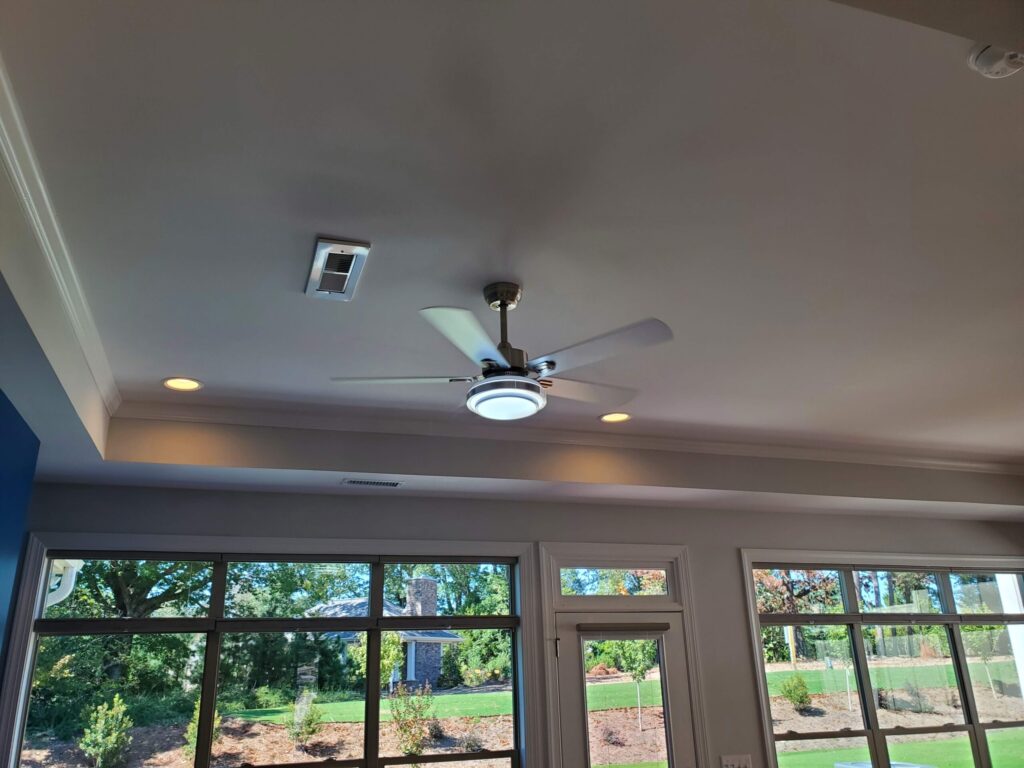
The biggest energy savings from a ceiling fan come from cutting down how long your air conditioner actually runs each day. Central air systems and window units draw the most power during the compressor cycle, the phase that physically cools and dehumidifies the air. When you raise your thermostat a few degrees thanks to fan comfort, the system reaches its set point faster and shuts off sooner. Shorter and less frequent compressor cycles translate directly into lower kilowatt hour usage on your meter. Across a hot stretch of July, those small reductions repeat hundreds of times and quietly build into noticeable savings. The fan itself uses a fraction of the power that the compressor demands, so the trade is heavily in your favor. This is the core financial logic behind running fans and AC together rather than relying on the air conditioner alone.
Reducing runtime also extends the working life of your air conditioning equipment, which protects you from costly repairs and early replacement. Every time the compressor starts and stops, it experiences mechanical and electrical stress that slowly wears down components. Fewer cycles mean less wear on the compressor, the contactor, and the fan motor inside the condenser unit. An air conditioner that runs less also collects less dust and debris in its filters and coils, which keeps it operating efficiently. Homeowners who lean on ceiling fans often find their AC needs fewer service calls over the years. The combined effect saves money on both the monthly bill and the long term maintenance budget. Protecting your cooling investment is one more reason to make ceiling fans a regular part of your summer routine.
The savings grow even larger when ceiling fans are placed strategically throughout the home rather than concentrated in a single room. A fan in the bedroom lets you sleep comfortably overnight while the thermostat sits a few degrees higher until morning. A fan in the main living area keeps the family room comfortable during the busiest hours of the day without forcing the AC to overwork. Kitchens, home offices, and sunrooms all benefit from targeted airflow that keeps occupied spaces pleasant. When every frequently used room has its own fan, you can keep the whole house thermostat set higher with confidence. This whole home approach multiplies the runtime savings across every cooling cycle. If you are ready to add fans to several rooms, our ceiling fan installation service can wire and mount each one safely and correctly.
How Ceiling Fans Lower Cooling Bills with Correct Blade Direction
Blade direction is one of the most overlooked settings, yet it has a direct impact on how much a ceiling fan helps in summer. During the warm months, the blades should spin counterclockwise when you look up at them from below. This counterclockwise rotation pushes air straight down and creates the downdraft that produces the cooling wind chill effect on your skin. A fan spinning the wrong way in summer pulls air upward instead, which scatters the breeze and erases most of the comfort benefit. Most ceiling fans include a small switch on the motor housing that flips the direction between summer and winter modes. Checking that switch at the start of the cooling season is a free five minute task that protects your savings. Many homeowners never realize their fan has been running backward for years, costing them comfort and money.
The strength of the downdraft also depends on the angle and pitch of the fan blades, which is built into the fan you purchase. Blades with a steeper pitch move more air per rotation and create a more powerful cooling breeze at the same speed. Quality fans are engineered with the right blade pitch and motor torque to deliver strong airflow without excessive noise or wobble. A cheap fan with flat blades may spin quickly yet still fail to move enough air to feel cooling. This is why blade design and build quality matter as much as the direction setting itself. Investing in a well made fan pays off through years of quiet, effective cooling. Choosing the right model for each room is a decision a professional electrician can help guide.
Seasonal direction changes are part of a smart year round strategy, since the same fan helps in winter when reversed. Flipping the blades to clockwise in the colder months creates a gentle updraft that pulls warm air off the ceiling and redistributes it down the walls. That winter mode can reduce heating costs by spreading trapped warm air back into the living space. For summer though, counterclockwise is the only setting that delivers the cooling you want. Building the habit of checking blade direction twice a year keeps your fans working at peak performance through every season. This tiny adjustment is one of the simplest ways to get the full value out of every fan in your home. Once you understand it, the setting becomes second nature.
What Makes a Ceiling Fan Lower Cooling Bills More Effectively
Not every ceiling fan delivers the same savings, and several practical factors decide how much you actually cut from your bill. The quality of the motor, the size of the fan relative to the room, the mounting height, and the way you operate the fan all shape the final result. A premium fan with an efficient motor draws very little power while moving a large volume of air. A poorly chosen or badly installed fan can underperform and leave you reaching for the thermostat anyway. Proper installation by a licensed electrician ensures the fan is balanced, securely mounted, and wired to the correct circuit. These details separate a fan that genuinely saves money from one that simply spins. Understanding what makes a fan effective helps you get the most return from your investment.
What Makes Ceiling Fans Lower Cooling Bills Through Motor Efficiency
The motor inside a ceiling fan determines both how much air it moves and how much electricity it consumes. Modern fans often use DC motors, which are significantly more efficient than the older AC motors found in many existing fans. A DC motor can move the same amount of air while using up to seventy percent less power than a comparable AC motor. That efficiency means the fan adds almost nothing to your bill while still letting you raise the thermostat for big compressor savings. Efficient motors also tend to run quieter and last longer, which improves comfort and reduces replacement costs. When you choose a fan for a frequently used room, motor type is one of the most important specifications to consider. The small extra cost of an efficient motor pays for itself over a few cooling seasons.
Energy Star certified ceiling fans take efficiency a step further by meeting strict standards for airflow per watt of power consumed. These certified models are tested to confirm they deliver strong air movement without wasting electricity. Choosing an Energy Star fan gives you confidence that the product will perform the way the savings math assumes. Pairing an efficient fan with an efficient lighting kit can further reduce the energy used in a room. Many of these fans also include LED light kits that replace the heat producing incandescent bulbs of older fixtures. Lower bulb heat means the room stays cooler and the AC works even less. If you want efficient lighting throughout your home, our interior lighting installation service can upgrade your fixtures with energy saving options.
Proper electrical wiring supports motor efficiency by delivering steady, clean power to the fan throughout its life. A fan connected to an overloaded or undersized circuit may run poorly and even pose a safety risk. An efficient motor only performs as designed when it receives the correct voltage and a secure connection. Loose wiring or an aging junction box can cause flickering, humming, or premature motor failure. A licensed electrician verifies the circuit, secures every connection, and confirms the fan is rated for its mounting location. This attention to the electrical foundation protects both your savings and your safety. Good wiring is the quiet partner that lets an efficient motor do its job for many years.
What Makes Ceiling Fans Lower Cooling Bills Through Correct Sizing
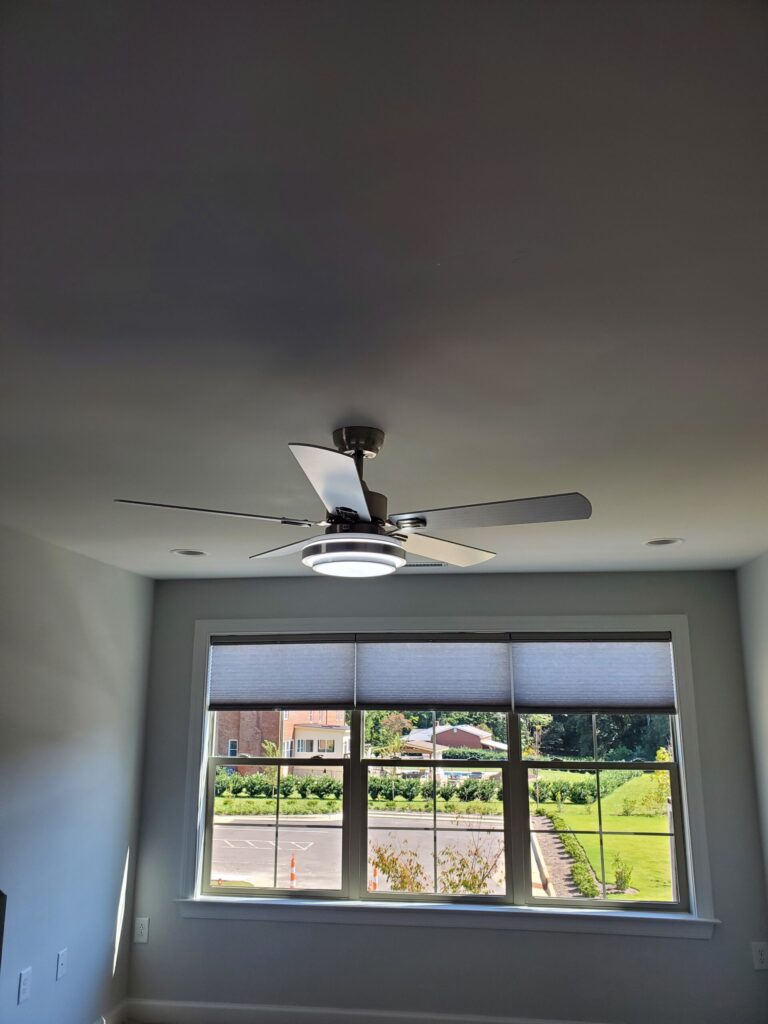
Fan size must match room size for the airflow to reach the people who need it, and this is where many homeowners go wrong. A fan that is too small for a large room cannot circulate enough air to create a meaningful wind chill effect. Industry guidance pairs blade span with square footage, so a small bedroom needs a smaller fan than an open concept living room. A room up to seventy five square feet works well with a fan around thirty six inches in blade span. Larger rooms in the range of two hundred to four hundred square feet need fans of fifty two inches or more. Getting the size right ensures the moving air actually reaches the seating and sleeping areas. An undersized fan forces you back to the air conditioner and erases the savings you hoped to gain.
Ceiling height factors into sizing just as much as floor area when planning for effective airflow. A fan mounted too close to a high ceiling cannot push air all the way down to where people sit. For tall ceilings, a downrod extends the fan to the ideal hanging height of roughly eight to nine feet above the floor. For low ceilings, a flush mount or hugger style fan keeps the blades safely out of the way while still moving air. Matching the mount type to the ceiling height keeps the downdraft strong and the room comfortable. A professional electrician evaluates the ceiling and selects the correct downrod or mount for each space. This step ensures the fan delivers its full cooling potential rather than spinning uselessly near the ceiling.
Multiple fans may be the right answer for very large or oddly shaped rooms where a single fan cannot cover the entire space. A long great room or a combined kitchen and dining area often benefits from two fans working together. Spacing the fans evenly creates overlapping zones of moving air that keep the whole space comfortable. This approach keeps every seating area in the breeze without forcing a single fan to spin at maximum speed. Proper placement also avoids dead spots where the air sits still and warm. An experienced electrician can map out the ideal fan layout for your room and handle the wiring for each unit. Thoughtful placement turns a difficult space into one that stays cool with minimal AC use.
What Makes Ceiling Fans Lower Cooling Bills Through Smart Usage Habits
How you use a ceiling fan matters just as much as the fan you choose, since even the best fan wastes money if used incorrectly. The most important habit is turning the fan off when you leave the room, because the fan cools people and not empty spaces. A fan left running in a vacant room only adds to your bill without delivering any comfort in return. Treating fans like lights, on when occupied and off when empty, captures the savings and avoids the waste. This simple discipline is the difference between a fan that lowers your bill and one that quietly raises it. Building the habit across the whole family keeps every fan working in your favor.
Coordinating fan use with thermostat settings is the second habit that unlocks the full savings potential of any ceiling fan. The fan only helps your wallet when you actually raise the thermostat to take advantage of the added comfort. Many homeowners run the fan while leaving the AC set to the same cold temperature, which captures none of the savings. The correct approach is to nudge the thermostat up several degrees once the fan is running and the room feels comfortable. Programmable and smart thermostats make this easy by holding the higher setting automatically during the day. Tying fan use to a slightly higher thermostat is where the real dollar savings live. Without this step, the fan is just a nice breeze rather than a money saving tool.
Seasonal maintenance keeps your fans running efficiently and quietly through every summer for years to come. Dust builds up on blades over time and can throw the fan out of balance, causing wobble and noise. Wiping the blades clean every few weeks during heavy use keeps the airflow smooth and the motor happy. Checking that mounting screws stay tight prevents the wobble that wears out a fan early. Confirming the blade direction is set to counterclockwise at the start of each cooling season protects your comfort. A quick seasonal check takes only minutes and keeps every fan delivering full value. If a fan starts humming, flickering, or wobbling badly, an electrical issue may be the cause and a professional should inspect it.
Why You Need a Professional to Get the Most Savings From Ceiling Fans
Getting real savings from ceiling fans starts with correct installation, sizing, and wiring, and that is where a licensed electrician makes the difference. A fan is heavier and more complex than a simple light fixture, and it must be mounted to a brace rated to hold its weight and motion. Improper mounting leads to wobble, noise, and in serious cases a fan that falls from the ceiling. Correct wiring protects your home from overloaded circuits and electrical hazards. Whiting Electrical Services installs every fan to code with the right brace, mount, and circuit for your space. Trusting the work to a professional means your fans stay safe, quiet, and efficient for years. The result is comfort and savings you can rely on through every New Hampshire summer.
Why You Need a Professional Ceiling Fan Installation for Safety
Ceiling fan installation carries safety risks that go beyond what most homeowners can handle on their own. A fan can weigh fifteen to fifty pounds and spins for hours, so it must be anchored to a fan rated electrical box and brace. A standard light fixture box is not built to support that weight or the constant vibration of a spinning fan. A licensed electrician installs the correct brace and confirms it is fastened to a ceiling joist or rated support. This step prevents the fan from loosening over time and eventually falling. Professional installation gives you peace of mind that the fan is anchored to last.
Electrical safety is the second major reason to leave fan installation to a trained professional. Wiring a fan involves working with live circuits, grounding, and sometimes adding a wall switch or remote control. Mistakes in the wiring can cause shorts, shocks, or fire hazards that put your family at risk. An electrician confirms the circuit can handle the fan, secures every connection, and grounds the unit correctly. If a fan needs a new circuit or a switch relocation, that work calls for licensed expertise. Our electrical repair service can resolve any wiring problem standing between you and a safe, efficient fan.
Code compliance protects both your safety and the value of your home when fans are installed. New Hampshire follows the National Electrical Code, and proper fan installation must meet those standards. A licensed electrician knows the code requirements for boxes, grounding, and circuit loads. Work done to code passes inspection and avoids problems when you sell or insure your home. A professional also documents the work and stands behind it with a warranty. Cutting corners on installation risks safety violations and voids most manufacturer warranties. Choosing a professional keeps everything correct from the first day.

Why You Need a Professional to Maximize Ceiling Fan Energy Savings
A professional electrician helps you capture the full energy savings that ceiling fans can deliver across your home. The savings depend on choosing the right fan size, motor type, and mounting height for each room. An electrician evaluates your spaces and recommends fans that will actually move enough air to let you raise the thermostat. This guidance prevents the common mistake of buying an undersized or inefficient fan that disappoints. Matching the fan to the room is the foundation of real, repeatable savings. Professional advice turns a guess into a plan that pays off.
Whole home planning is another way a professional boosts your overall energy savings beyond a single room. An electrician can map out which rooms benefit most from fans and how to wire them efficiently. Adding fans to bedrooms, living areas, and offices lets you keep the whole house thermostat higher during peak heat. Coordinating fans with smart thermostats and efficient lighting compounds the savings further. A professional sees the whole picture rather than one fan at a time. This big picture approach delivers far more savings than piecemeal upgrades.
Proper wiring and circuit planning protect both your savings and your equipment over the long run. A fan on a properly loaded circuit runs smoothly and uses power efficiently. An electrician confirms the circuit, balances the load, and prevents the flickering or humming that signals trouble. Clean, correct wiring keeps efficient motors performing as designed for many years. This attention to detail protects the investment you made in quality fans. A professional foundation ensures your savings continue season after season.
Why You Need Whiting Electrical Services for Your Ceiling Fan Installation
Whiting Electrical Services brings trusted, professional craftsmanship to every ceiling fan installation across the Laconia area. We back our work with a Lifetime Craftsmanship Warranty, so you can count on every fan being installed to last. Our team holds an A rating with the Better Business Bureau, a reflection of our commitment to quality and honest service. We have earned the trust of major clients including Mr. Beast and WillScot for our electrical work. That reputation is built on doing every job right, from the smallest fan to the largest project. When you hire us, you get an electrician who treats your home with care and respect.
We make professional electrical service accessible and rewarding for the families we serve throughout New Hampshire. We proudly offer a ten percent discount for veterans, first responders, and paramedics as a thank you for their service. Our team is dedicated to delivering a five star experience on every visit, every time. We show up on schedule, explain the work clearly, and leave your home clean. As a Generac Certified Dealer and Service Provider, we bring the same certified expertise to all of our electrical work. Choosing us means choosing a company that stands behind its reputation.
Ready to cool your home and lower your summer bills with professional fan installation? Our skilled electricians will size, mount, and wire every fan for maximum comfort and savings. Want a quote or expert advice on the best fans for your home? Click here for our ceiling fan installation service and let us handle the rest. Call Whiting Electrical Services today at (603) 512-3887 to schedule your installation and start saving this summer. We are here to keep your home cool, safe, and efficient through every New Hampshire season.