
The Safe Way to Power Outdoor Holiday Decorations in Cold Weather
Outdoor holiday displays put more strain on a home electrical system than most homeowners expect, and cold weather makes every weak point worse. Water finds its way into cheap connections, plastic cord jackets stiffen and crack in single digit temperatures, and snow melt refreezes right where two plugs meet. A display that ran fine on a mild November evening can trip a breaker, blow a GFCI, or start arcing once temperatures drop below freezing and ice builds up around the connections. The good news is that safe outdoor holiday power comes down to a short list of practical rules involving the right outlets, the right cords, and a realistic understanding of how much load a single circuit can carry. Homeowners across Laconia, Gilford, Meredith, Belmont, and Concord deal with lake effect moisture, heavy wet snow, and long stretches of subfreezing weather, so the margin for error here is smaller than it is in warmer parts of the country. This guide walks through how to power outdoor holiday decorations correctly, which mistakes cause the most service calls every December, and when it makes sense to have a licensed electrician add proper outdoor circuits before the season starts. Getting the setup right protects your home, your family, and the display you spent a weekend hanging.
How to Power Outdoor Holiday Decorations Safely in Cold Weather
Safe outdoor holiday power starts at the receptacle and works outward toward the display. Every outlet feeding decorations outside needs ground fault protection, a weatherproof cover that closes over the plug while it is in use, and a circuit with enough capacity left over to handle the added load. From there, the cords carrying power across the yard have to be rated for outdoor use, sized correctly for the distance they travel, and routed so that water drains away from the connections instead of pooling inside them. Cold weather adds one more layer to the equation, since low temperatures make ordinary vinyl insulation brittle and cause thermal cycling that loosens plugs over time. Most homeowners think about the lights first and the power source last, which is exactly backward. Plan the electrical side first and the display becomes far easier to run all season without a single trip to the panel in the dark.
The Right Outlets for Outdoor Holiday Decorations in Cold Weather
Every outdoor receptacle serving holiday decorations must be protected by a ground fault circuit interrupter, and this is not a suggestion or a best practice; it is a requirement of the National Electrical Code for outdoor receptacles at dwellings. A GFCI monitors the current flowing out on the hot conductor and back on the neutral, and when it detects a difference of roughly five milliamps it shuts the circuit off in a fraction of a second. That difference means current is escaping somewhere it should not go, and in a wet yard the most likely path is through a person standing on frozen ground. Snow, sleet, and freezing rain create exactly the conditions where a small insulation fault turns into a serious shock hazard. If your outdoor outlets do not have a test button or are not fed from a GFCI breaker in the panel, you should not be running decorations from them until that protection is added. Older homes throughout Belknap and Merrimack counties frequently have exterior outlets installed long before these rules applied, and homeowners assume the outlet is protected simply because it is outside. Testing takes about ten seconds and it is worth doing every year before the first string goes up.
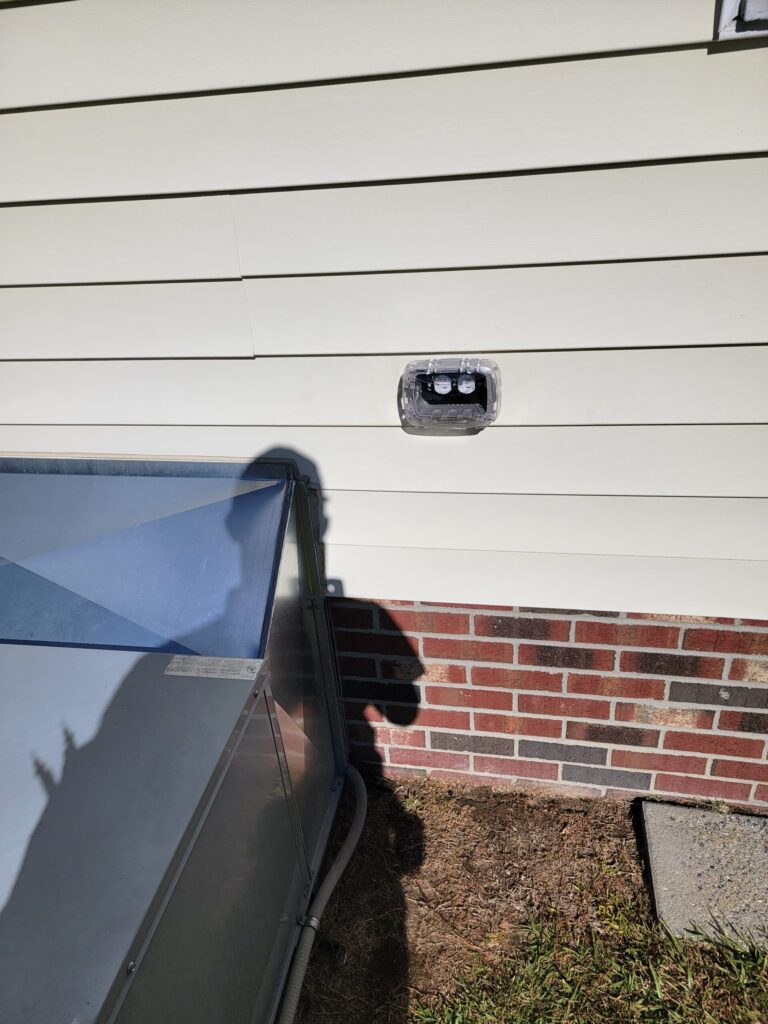
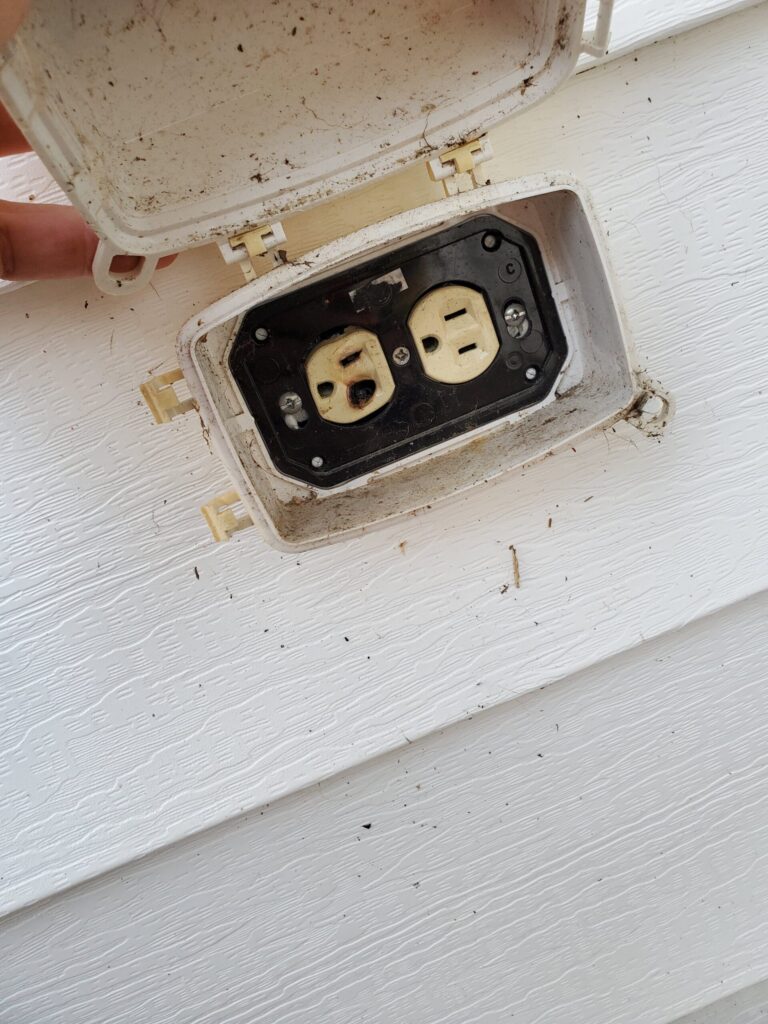
The cover matters just as much as the protection behind it. An outdoor receptacle in a wet location needs what the code calls an in use cover, which is the bubble style enclosure that stays closed and sealed even with a cord plugged in. The older flip lid covers only protect the outlet when nothing is plugged into it, which is useless for a holiday display running around the clock for six weeks. Covers installed on new work must also meet the extra duty rating, meaning they are built to survive impact and ultraviolet exposure without cracking, and that durability matters a great deal in a climate where a cover gets hit by ice, snow shovels, and roof runoff. A cracked cover lets meltwater sit directly on the plug blades, and once that water freezes and expands it can push the plug partially out of the receptacle. Partial contact creates resistance, resistance creates heat, and heat at a plug face is how connections burn. Replacing a failed cover costs very little compared to replacing a scorched receptacle and the siding behind it.
Placement is the third piece homeowners overlook. An outlet mounted low on a foundation wall will spend February buried under a plow bank, and one tucked under a gutter without a diverter will take a steady drip all winter long. The best locations for holiday display power are protected under a soffit or an overhang, high enough to stay above typical snow depth, and positioned so that cords run downhill away from the receptacle rather than uphill toward it. A simple drip loop, where the cord dips below the outlet before rising to the plug, lets gravity pull water off the cord instead of guiding it into the connection. Many homes only have one exterior outlet near the front door, which forces cords to travel much farther than they should. Adding two or three properly placed exterior receptacles is a straightforward job for a licensed electrician and it permanently solves the annual cord routing problem. Planning a display this year? Click here for our outdoor lighting installation service and let us handle the power side before the ground freezes.
Choosing Extension Cords That Power Outdoor Holiday Decorations in Cold Weather
Extension cords are the single most abused component of any holiday display, and the cheapest ones fail first in cold weather. A cord intended for outdoor use carries a W marking on the jacket, which indicates it is built to resist moisture and sunlight, and it should also carry a listing mark from a recognized testing laboratory. Indoor cords, including the flat brown ones sold for lamps, have thin insulation that hardens and splits once temperatures drop into the teens, and a split jacket in a snowbank is a direct path to ground. Cords with rubber or thermoplastic elastomer jackets stay flexible in deep cold far better than standard vinyl, which is why professional installers pay more for them. Flexibility matters because a stiff cord that gets stepped on or bent around a railing develops internal conductor breaks you cannot see. Those hidden breaks raise resistance at one spot, which produces heat under load, and the failure usually shows up as a warm section of cord or an intermittent set of lights. Buy the better cord once and it will serve you for a decade.
Gauge selection is the part most homeowners guess at, and guessing costs you voltage. Wire gauge numbers run backward, so 12 gauge copper is thicker than 14 gauge and 14 gauge is thicker than 16 gauge. A 16 gauge cord is acceptable for a light load over a short run, but once you push past fifty feet or start adding inflatable blowers and motorized figures, you want 14 gauge or 12 gauge to keep voltage drop under control. Excessive voltage drop makes motors run hot, dims incandescent bulbs, and shortens the life of LED drivers, and none of that is obvious from the curb. Cords should also be run at full length rather than left coiled on a reel, because a tightly coiled cord under load traps heat inside the coil. In cold weather that heat buildup is easy to dismiss as harmless, but the insulation does not know what month it is. Match the gauge to the distance and the load, and the display runs cooler and brighter.
How you route and connect cords determines how long they survive the season. Never staple or nail through a cord jacket, since a fastener driven into the insulation can contact a conductor immediately or work its way in over weeks of wind movement. Use plastic insulated hooks or clips designed for the job, and support the cord frequently enough that its own weight is not pulling on the connections. Connection points should be kept off the ground and out of snow accumulation, ideally hung on a hook or supported on a block, and the joint between two plugs benefits from a purpose built cord connector cover or a weatherproof connection box. Wrapping a connection in electrical tape and a plastic bag is a common trick that actually traps water inside instead of shedding it, so skip it. Do not run cords through window sashes or under doors where they get pinched every time the door closes. Count your connections before you buy, keep the total number low, and inspect every cord for cracks and exposed copper before it goes outside.
Circuit Load Limits for Outdoor Holiday Decorations in Cold Weather
The math behind circuit capacity is simple and almost nobody does it. A standard 15 amp, 120 volt circuit can supply 1,800 watts at its absolute maximum, but any load running longer than three hours is considered continuous, and continuous loads are limited to 80 percent of the circuit rating. That works out to about 1,440 watts on a 15 amp circuit and roughly 1,920 watts on a 20 amp circuit. A holiday display running from dusk until midnight is unquestionably a continuous load. Now subtract everything else already on that circuit, because exterior outlets are frequently shared with garage receptacles, a basement freezer, or a bathroom, and those loads do not disappear because it is December. What looks like plenty of headroom on paper often turns out to be a few hundred watts once the real world is accounted for.
Light technology changes the numbers dramatically. Old C9 incandescent bulbs draw roughly seven watts each, so a single hundred bulb run consumes about 700 watts and two runs will nearly max out a 15 amp circuit by themselves. LED versions of the same bulb typically draw well under one watt, which means the same visual result costs a small fraction of the load. Inflatable decorations are the other surprise, since each one contains a continuous duty blower motor that draws real current and pulls an inrush spike every time it cycles on. Motorized projectors, animated figures, and heated elements all add up faster than strings of lights do. Add the wattage listed on every tag and box before you plug anything in, then compare that total against the 80 percent figure for the circuit. Switching an older display to LED is usually the single most effective way to bring a marginal circuit back into safe territory.
Breakers that trip repeatedly are telling you something useful, and the answer is never a larger breaker. Circuit breaker size is matched to the wire gauge behind it, so replacing a 15 amp breaker with a 20 amp breaker on 14 gauge wire removes the protection that keeps the wire from overheating inside your walls. If a circuit cannot carry the display, the correct fixes are reducing the load, splitting the display across multiple circuits, or having a dedicated exterior circuit installed. A GFCI that trips repeatedly is a different message entirely, since that device is reporting current leaking to ground somewhere in the display. Chasing that fault means unplugging sections one at a time until the tripping stops, and the guilty section usually has a cracked socket, a damaged cord, or water in a connector. Nuisance tripping in wet weather is common with older mechanical GFCI devices, though modern units are considerably more stable. Persistent tripping after you have dried and inspected everything deserves a professional look before the season goes any further.
Common Mistakes That Make Outdoor Holiday Decorations Unsafe in Cold Weather
The service calls electricians run every December follow a predictable pattern, and almost all of them trace back to four or five avoidable decisions. Water intrusion at connection points leads the list, followed closely by circuits loaded past their limit and indoor rated equipment pressed into outdoor duty. Timers and smart plugs designed for a bedroom lamp end up bolted to a porch post, and their contacts corrode within a few weeks of exposure. Then there is the physical side of the job, where ladders on frozen ground and overhead service conductors create a genuine risk of injury that has nothing to do with the decorations themselves. Understanding these failure modes ahead of time takes very little effort and prevents the kind of problem that ends a holiday early. Each one has a straightforward fix that costs less than the damage it avoids.
Water and Ice Damage to Outdoor Holiday Decorations in Cold Weather
Water damage rarely announces itself at the moment it happens. Meltwater works into a plug connection during a mild afternoon, refreezes overnight, and expands slightly as it turns to ice, and that expansion pries the contacts apart just enough to create a gap. The next time the display energizes, current has to jump that gap or squeeze through a smaller contact area, and both conditions generate heat. Repeat that cycle across a New Hampshire winter and the plug face darkens, the blades pit, and eventually the connection fails or arcs. This is why elevated, covered connections matter far more than the quality of the lights hanging from them. Rooftop and gutter mounted decorations are especially vulnerable because everything that melts off the roof funnels straight down the same path your cord follows.
Corrosion works on a slower timeline but ends in the same place. Salt from road spray, mineral content in runoff, and simple oxidation build a resistive film on plug blades and inside sockets, which raises the temperature at that junction under load. A light dielectric grease on connections that must live outdoors slows this process considerably and makes spring disassembly much easier. Sockets on light strings deserve inspection too, since a missing bulb leaves an open socket that collects water directly on the contacts. Always replace missing bulbs rather than leaving the gap, and discard any string with a cracked socket instead of trying to nurse it through one more year. Store everything dry at the end of the season, because a cord coiled wet in a garage will corrode all summer.
Snow load creates a mechanical problem that turns into an electrical one. Heavy wet snow sliding off a roof can rip a light string free of its clips, and that sudden yank puts the entire force onto whatever connection is closest. Ground stakes for pathway lights get pushed sideways by plows and shovels, breaking the low voltage leads underneath. Inflatable decorations left standing in a storm collapse under snow weight, and the blower keeps running inside a wet, compressed envelope. Plan the display so that nothing sits directly in the path of a roof avalanche, and mark stake locations clearly so snow removal does not destroy them. Take inflatables down before a major storm rather than after. A few minutes of preparation before the forecast arrives saves both the decorations and the circuit feeding them.
Overloaded Circuits Behind Outdoor Holiday Decoration Failures in Cold Weather
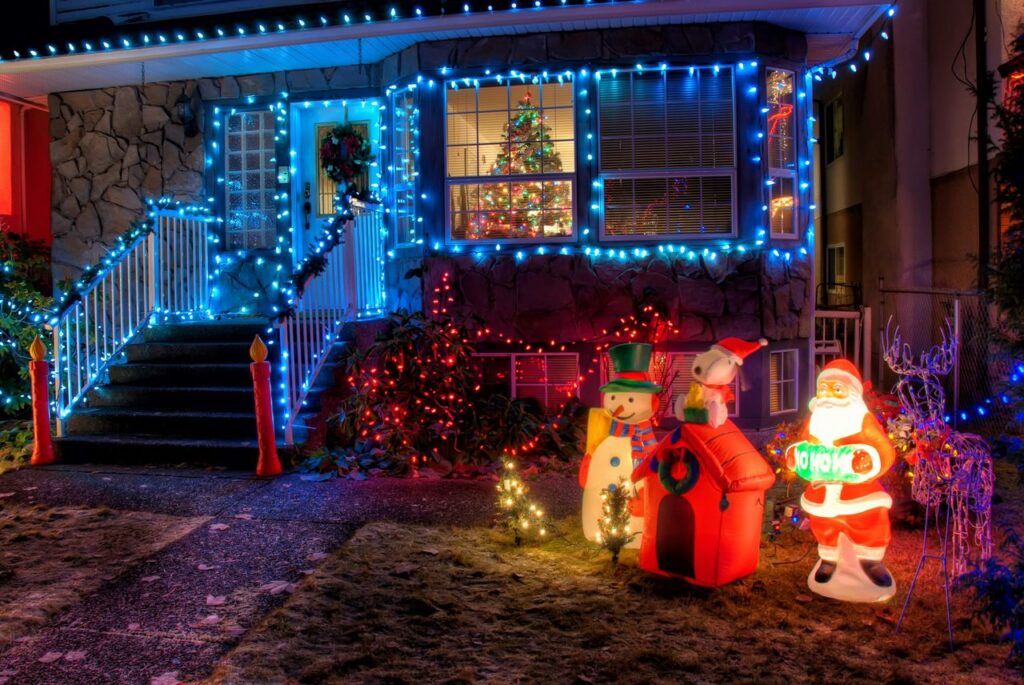
Overloading usually happens gradually rather than all at once. A homeowner adds one more section each year, plugs a new run into the same convenient outlet, and never recalculates the total. The circuit handles it until an especially cold night when the garage freezer runs longer, the space heater in the workshop kicks on, and the breaker finally opens. Because the failure feels random, people blame the breaker instead of the load, and that misreading leads to some genuinely dangerous decisions. Multiplug adapters and daisy chained power strips are the usual response, and they do nothing except move the failure point closer to the display. Any device that lets you plug six things into one receptacle has not increased the capacity of the wire in the wall by a single amp.
Daisy chaining light strings past the manufacturer limit is its own specific hazard. Every string carries a tag stating the maximum number of connected sets, and that number exists because the internal conductors and the plug on the first string carry the current for everything downstream. Exceeding it puts the entire display load through a small gauge wire that was never sized for it. LED strings generally allow longer runs than incandescent strings because their current draw is so much lower, but the limit still applies and it is still printed on the tag. Never combine incandescent and LED sets in the same chain without checking the ratings for both. When you need more length than one chain allows, run a separate cord back to the power source instead of extending the chain.
The permanent solution for a display that keeps outgrowing its circuit is a dedicated exterior circuit. A licensed electrician can run a new 20 amp circuit from your panel to weatherproof receptacles placed where you actually need them, with GFCI protection and extra duty in use covers included. That circuit serves the display in winter and handles power tools, pressure washers, and yard equipment the rest of the year, so it earns its cost quickly. If your panel is already full or you are working with an undersized service, that conversation may include a subpanel or a service upgrade. Homes still running 100 amp service with a full panel often hit this wall right when they want to add something new. Tripping breakers every December? Click here for our circuit breaker installation service and we will size the solution correctly the first time.
Ladder and Overhead Wire Hazards While Hanging Outdoor Holiday Decorations in Cold Weather
The most serious injuries associated with holiday lighting have nothing to do with the lights. Ladders placed on frozen ground, wet leaves, or packed snow slip without warning, and a fall from gutter height causes real harm. Set ladder feet on a solid, level surface, use a stabilizer at the top so the rails do not rest on the gutter itself, and have someone hold the base whenever possible. Use a fiberglass ladder rather than aluminum for any work near electrical conductors, since fiberglass rails do not conduct. Keep your hips between the rails instead of reaching sideways to save a trip down. Cold hands and bulky gloves reduce grip strength considerably, which is one more reason to move the ladder more often than feels necessary.
Overhead service conductors deserve genuine caution and a wide berth. The wires running from the utility pole to the connection point on your house carry full service voltage, and the insulation on older overhead drops can be weathered and unreliable. Maintain at least ten feet of clearance between yourself, your ladder, any pole, and those conductors at all times. Never hang decorations from the service mast, the weatherhead, or the drip loop where the conductors enter the house, and never route a cord across or around them. If a tree you want to decorate has branches near the service drop, leave that tree alone and call the utility about the clearance issue instead. Aluminum ladders and long poles make contact far easier than people expect, especially in wind.
Weather timing is the last piece of the safety picture. Hanging decorations on an icy roof or in gusty wind turns a routine task into a hazardous one, and there is no decoration worth a trip to the emergency room. Pick a dry day with light wind, ideally before the first significant snowfall while the ground is still firm. Assemble as much as possible at ground level, then lift finished sections into place so your time on the ladder stays short. Have a plan for taking everything down too, because January removal frequently happens in worse conditions than December installation. Many homeowners in the Lakes Region simply hire out rooftop and second story work, and that is a reasonable decision. Ground level displays are well within reach for most people; everything above that is worth a second thought.
Why You Need a Licensed Electrician for Outdoor Holiday Decorations and Cold Weather Power
There is a clear line between decorating and electrical work, and it sits at the receptacle. Plugging in a properly rated cord on a protected outlet is homeowner territory; adding circuits, installing exterior receptacles, replacing panels, and diagnosing repeated faults is licensed work for good reason. A licensed electrician sizes conductors correctly, provides the right protection, and installs equipment rated for the actual conditions it will face through a New Hampshire winter. That work also gets inspected and documented, which matters for insurance and for anyone who buys the house later. Doing it right once removes the annual scramble for extension cords and outlet splitters entirely. It also removes the risk that a holiday display becomes the reason for a much larger repair.
Adding Outdoor Outlets Before Holiday Decorations Go Up in Cold Weather
The best time to add exterior receptacles is early fall, before the ground freezes and before the seasonal rush begins. An electrician evaluates where your display actually needs power, checks available capacity in the panel, and runs new circuits to the right locations with GFCI protection and extra duty covers. Placement is chosen with snow depth, roof runoff, and cord routing in mind rather than construction convenience. Most homes benefit from receptacles near the front entry, at the garage side, and somewhere along the rear or side yard. These outlets pay for themselves the first time you skip running a hundred feet of cord out a window.
Switched or timer controlled exterior outlets add convenience that lasts well beyond December. An outdoor rated timer or a switch located inside the house means nobody stands in the snow unplugging cords at midnight. Photocell control turns the display on at dusk automatically and shuts it off at a set hour, which reduces run time and energy cost. Equipment installed for permanent outdoor duty is built for temperature swings and moisture exposure in a way that indoor rated smart plugs simply are not. The difference shows up in the second or third season, when the cheap unit has already corroded. Specify outdoor rated control gear from the start and forget about it.
Existing outlets sometimes need attention rather than replacement. An older exterior receptacle without ground fault protection can often be upgraded in place, and a failed cover is a quick swap. An outlet on a shared circuit with no capacity left is a different problem, and that one calls for a new home run from the panel. A quick inspection tells you which situation you are in before you commit to anything. Missing GFCI protection outside? Click here for our GFCI outlet installation service and get the right protection in place before the display goes up.
Surge Protection and Panel Capacity for Outdoor Holiday Decorations in Cold Weather
Winter storms bring more than snow, and utility switching, downed lines, and equipment faults all produce voltage transients that travel into the house on the service conductors. Those surges damage LED drivers, timers, inflatable blowers, and every piece of sensitive electronics inside the home. A whole house surge protective device installed at the panel clamps those transients before they reach branch circuits, which protects the display and everything else at the same time. It is a single installation that works quietly for years without any attention. For homes with substantial LED lighting and smart controls, the protection is worth considerably more than it costs.
Panel capacity is the other consideration that surfaces during the holidays. Older panels in the Lakes Region are frequently full, and some are still 100 amp services carrying loads they were never designed for. Adding a dedicated exterior circuit means having space and capacity available, and if neither exists the honest answer is a subpanel or a service upgrade. That work also opens the door to EV chargers, heat pumps, hot tubs, and generator connections down the road. An electrician can tell you exactly where you stand after a short evaluation.
Certain panel brands and older equipment carry known safety concerns, and holiday season load increases are often when those problems first appear. Breakers that feel warm, buzz, or refuse to reset are warning signs that deserve immediate attention rather than a spring project. Scorching, a burning smell, or discoloration around a breaker means stop using that circuit and call someone. These are not conditions that improve on their own. Worried about your panel handling the winter load? Click here for our whole house surge protection service and let us evaluate your service at the same time.
Why Choose Whiting Electrical Services for Outdoor Holiday Decoration Wiring in Cold Weather
Whiting Electrical Services works in Laconia and throughout the Lakes Region, so our crews understand what a New Hampshire winter does to exterior electrical equipment. We install outdoor receptacles, dedicated circuits, GFCI protection, and surge devices with the local climate in mind rather than a generic specification. Every job we complete is backed by our Lifetime Craftsmanship Warranty, which reflects how seriously we take the quality of the work we leave behind. We hold an A rating with the Better Business Bureau and we are a Generac Certified Dealer and Service Provider. Companies including WillScot and MrBeast have trusted us with their electrical projects, and we bring the same standard to a residential porch outlet.
We also believe good service should be accessible, so we offer a 10 percent discount for veterans, first responders, and paramedics. Our team shows up on time, explains what we find in plain language, and gives you real options instead of a single expensive answer. If a simple upgrade solves the problem, that is what we will recommend. If your service genuinely needs more capacity, we will show you why and what it involves. Our goal on every call is a five star result, and we work until we get there.
Fall is the right time to handle exterior electrical work, before the ground freezes and before the first display goes up. Adding a couple of properly protected outdoor receptacles or a dedicated circuit now takes very little time and eliminates the cord problem permanently. We serve Laconia, Gilford, Meredith, Belmont, Alton, Franklin, Concord, Bow, Loudon, Hopkinton, Pembroke, Plymouth, Wolfeboro, Wakefield, and Farmington. Call Whiting Electrical Services at (603) 512-3887 or email Info@whitingelectricalservices.com to schedule an evaluation of your exterior power. We will make sure your holiday display runs safely all season long.