
When an Electrical Problem Becomes an Emergency You Should Not Ignore
Most electrical trouble in a home starts small, and that is exactly what makes it dangerous. A dimming light, a warm cover plate, or a breaker that trips once a month rarely feels urgent enough to interrupt a busy August weekend in the Lakes Region. The problem is that heat, moisture, and load are cumulative forces inside a wall, so a connection that has been slowly loosening for two summers does not fail politely; it fails all at once, usually on the hottest afternoon of the year when every circuit in the house is already working overtime. Knowing the difference between a nuisance and a genuine electrical emergency protects your family, your home, and the equipment you have invested in. This guide walks through the specific warning signs that mean you should stop using a circuit immediately, the summer conditions here in New Hampshire that push ordinary faults into emergency territory, and the reasons a licensed electrician needs to be the one who opens the panel. Whiting Electrical Services has spent years responding to calls in Laconia, Gilford, Meredith, Alton, and Concord where a homeowner waited a week too long, and the pattern is almost always the same. The good news is that nearly every emergency we respond to announced itself first.
Warning Signs an Electrical Problem Has Become an Electrical Emergency
Your home communicates electrical distress through your senses long before anything catches fire. Smell, touch, sound, and sight each carry information that a trained electrician reads the way a mechanic reads engine noise. The reason these signs matter so much is that they all point back to the same root condition, which is unwanted resistance somewhere in the circuit generating heat that the system was never designed to dissipate. Copper conductors, thermoplastic insulation, and device terminals all have defined temperature ratings, and once those ratings are exceeded the materials begin to degrade permanently. Degraded insulation does not repair itself when the load comes off, so every overheating cycle leaves the circuit weaker than it was before. Treat the following three signs as reasons to shut off the affected circuit and pick up the phone rather than reasons to schedule something for next month.
Burning Smells Signal an Electrical Emergency You Should Not Ignore
The odor of overheating electrical components is distinctive once you have encountered it, and it does not smell like woodsmoke or a scorched dinner. Homeowners most often describe it as hot plastic, melting crayon, or an oddly fishy chemical smell that seems to come from nowhere. That fishy note comes from the chemical breakdown of the thermoplastic insulation and the flame retardant compounds in receptacles, switches, and breaker housings as they cook past their rated temperature. The smell tends to be strongest near the outlet, switch, junction box, or panel where the fault lives, though air movement from a fan or an air handler can carry it across a room and confuse the search. Some homeowners notice it only at night when the house is quiet and the air is still. Others notice it only when a specific appliance runs, which is a strong clue about which circuit is involved. In every case, an electrical burning smell means material is actively being damaged right now, not that something might go wrong eventually.
The underlying causes are usually mechanical rather than mysterious. Loose terminations are the single most common source, because a screw that was never fully tightened, or one that has loosened through decades of thermal expansion and contraction, forces current across a small imperfect contact point that heats like a stove element. Receptacles wired using the push in holes on the back of the device, rather than the screw terminals on the side, are notorious for this failure mode because the internal spring loses tension over time. Homes built between the mid 1960s and the mid 1970s may contain aluminum branch circuit wiring, which oxidizes and creeps under pressure and requires specific approved repair methods such as COPALUM crimps or listed pigtail connectors. Overloaded circuits contribute as well, since conductors carrying current near or above their ampacity rating for extended periods run hot along their entire length inside the wall. Failing breakers add another layer, because a breaker with worn internal contacts can heat at the bus connection even while it continues to carry load. Rodent damage and water intrusion round out the list, and both are common in older New Hampshire housing stock with fieldstone foundations and unconditioned attic space.
The correct response to an electrical burning smell is immediate and simple. Identify the affected circuit if you safely can, switch that breaker to the off position, and stop using anything on it until an electrician has inspected the run end to end. Do not open the panel cover yourself, and do not remove a receptacle or switch plate to look inside, because the energized parts behind those covers are exactly where the fault is likely to be. If the smell is coming from the panel itself, or if you cannot isolate it to a single circuit, shut off the main breaker and call for help right away. If you see smoke or flame, leave the building and call 911 first. Nighttime and holiday failures are common in this trade, which is why our team stays available for exactly these situations. Smell something burning near an outlet or your panel? Click here for our emergency electrician service.
Hot Outlets and Scorch Marks Are an Electrical Emergency in Any Home
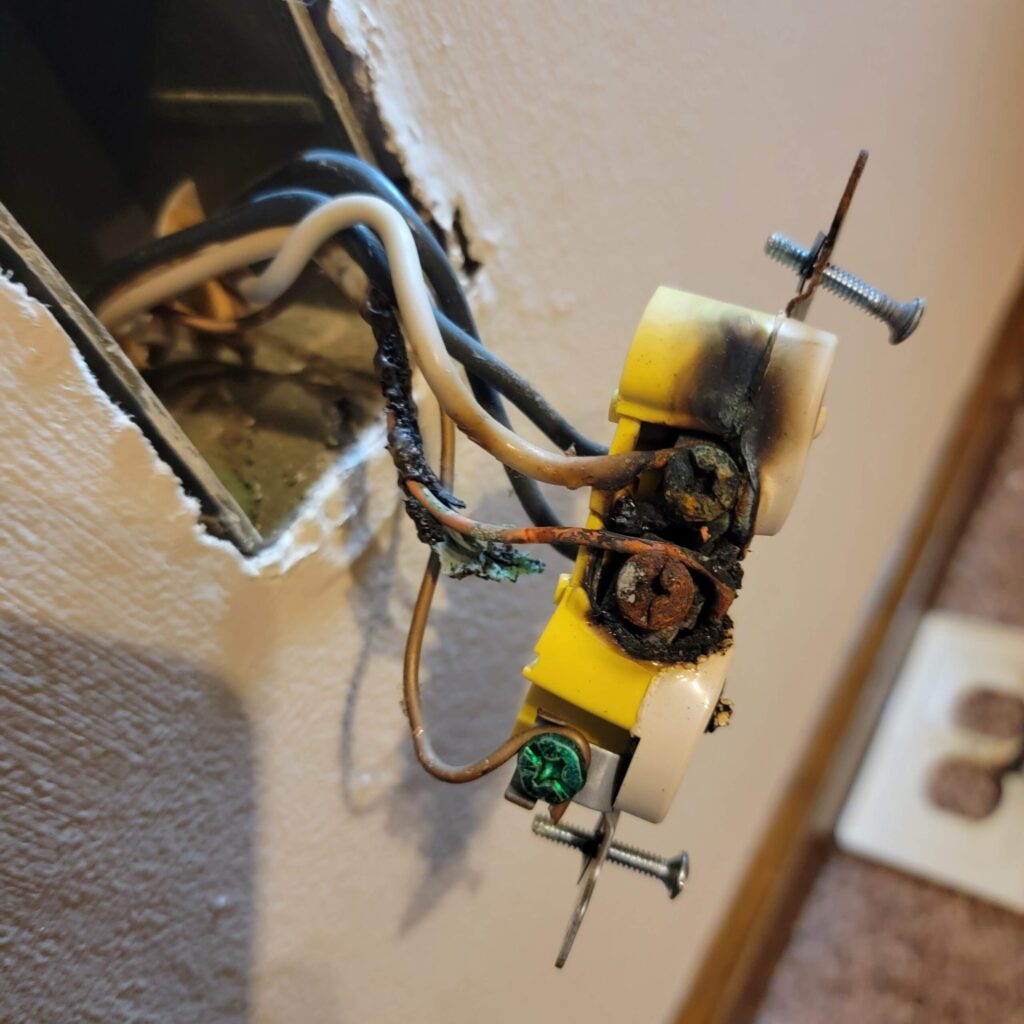
A properly functioning receptacle should feel the same temperature as the wall around it, even while an appliance is plugged in and running. Warmth you can feel through the cover plate means resistance is converting electricity into heat at a point that was designed to conduct, not to warm. Discoloration takes this a step further, and brown or yellow staining around the slots of an outlet is a record of heat events that have already occurred. Black scorch marks, bubbled plastic, or a melted slot edge represent arcing, which is current jumping a gap through the air at temperatures far higher than anything the surrounding drywall, insulation, or framing can tolerate. A cord plug that feels hot at the blades, or one that arrives at a loose fit and falls partway out of the receptacle, tells you the internal contacts have lost their grip. Loose contacts and arcing feed each other in a cycle that accelerates rather than stabilizes.
Certain locations in the home deserve extra scrutiny during the summer months. Window air conditioner outlets take a continuous heavy load for weeks at a time, and many of them are on older general purpose circuits that were installed when a room needed to power a lamp and a radio. Dehumidifier receptacles in basements combine steady motor load with damp air, which is a poor combination for any device with steel screws and brass contacts. Kitchen counter outlets serve high draw appliances in short bursts, and garage and workshop receptacles feed compressors and power tools with high starting current. Bathroom, kitchen, laundry, garage, basement, and outdoor receptacles all require ground fault circuit interrupter protection under current code, and a GFCI device that will no longer reset, or one that trips the moment you press reset, is telling you something real about the circuit rather than simply wearing out. Extension cords and power strips deserve mention here because they concentrate load through a single connection point and are never a substitute for adequate branch circuits. If your home relies on them daily, the underlying issue is a shortage of properly placed outlets.
Once you find a hot or discolored outlet, stop using it and shut off the breaker feeding it. Replacing the device yourself is tempting and inexpensive, but it addresses the symptom rather than the cause in most cases, because the damage frequently sits at a wire connection inside the box or at another point upstream on the same circuit. An electrician will check terminations at every device on the run, verify conductor size against breaker size, look for evidence of overheating in the box, and confirm the circuit is not carrying more load than its design allows. That inspection often turns up a backstabbed connection, a shared neutral problem, or an overloaded circuit that no amount of device replacement would have solved. Homes with older wiring benefit from having the full circuit evaluated rather than a single outlet swapped. Have outlets that feel warm or look scorched? Click here for our electrical repair service.
Repeated Breaker Trips Can Turn Into an Electrical Emergency Fast
Circuit breakers are safety devices, and a breaker that trips is doing precisely the job it was built to do. A standard breaker responds two ways, using a thermal element that reacts to sustained overload and a magnetic element that reacts almost instantly to a short circuit or a serious ground fault. When a breaker trips once during a thunderstorm or after you plugged a space heater into an already busy circuit, the cause is usually obvious and the fix is straightforward. Repeated tripping is an entirely different signal, because it means a condition on that circuit keeps recurring and the protective device keeps intervening. Each trip and reset cycle also wears the breaker mechanism, and a breaker that has operated many times may eventually fail to trip when it truly matters. The circuit that trips every few days is not being stubborn; it is reporting a fault that no one has found yet.
The dangerous version of this situation happens when someone decides the breaker is the problem and installs a larger one. A 15 amp breaker protects 14 gauge copper conductors, and a 20 amp breaker protects 12 gauge copper conductors, so replacing the smaller breaker with a larger one removes the protection those conductors depend on while leaving the wire in the wall unchanged. The wire then becomes the weakest link, and it will heat inside a stud bay where no one can see or smell it until damage is severe. We also encounter homes where two conductors have been landed under a single breaker lug that was never listed for that purpose, which creates a loose and overheating connection at the busbar. Older panels bring their own concerns, and certain vintage equipment has a documented history of breakers failing to trip under fault conditions. If your panel is crowded, corroded, warm to the touch, or humming and buzzing audibly, the panel itself has moved into the emergency category. Concerned about the condition of your panel? Click here for our electrical panel repair service.
There is one more tripping scenario that deserves urgent attention, and it involves lights that brighten and dim on their own across the house. That symptom often points to a loose or open neutral at the service, which allows voltage to swing above and below the normal 120 volts depending on how load is distributed between the two legs. High voltage on one leg destroys electronics, motors, and appliances in minutes, and the fault can sit at the weatherhead, the meter socket, the main lug connections, or on the utility side of the connection. Flickering confined to one fixture is usually a lamp or switch issue, while flickering across multiple rooms and circuits at the same time is a service level warning. Buzzing at the panel, a warm main breaker, or visible corrosion inside the enclosure supports the same conclusion. Shut down sensitive equipment, avoid running large loads, and call for service immediately rather than waiting to see what happens overnight.
Summer Conditions That Turn Common Electrical Problems Into Emergencies
New Hampshire summers put a specific and predictable kind of stress on residential electrical systems. Cooling equipment runs for hours without a break, humidity works its way into outdoor enclosures and basement boxes, pools and hot tubs mix water with 240 volt equipment, and afternoon thunderstorms send surges down utility lines and through communication cables. Each of these conditions is manageable on its own when the system was installed correctly and has been maintained. The trouble arrives when a marginal connection or an undersized service meets peak summer demand at the same moment. A house that coasted through a mild spring can develop a genuine emergency during the first sustained stretch of ninety degree weather. Understanding which summer conditions create the most risk lets you get ahead of the failures instead of reacting to them.
Air Conditioning Loads Create Summer Electrical Emergencies in New Hampshire Homes
Cooling equipment draws more current at startup than at any other point in its operating cycle, and that inrush stresses every connection between the panel and the compressor. Central systems and ductless heat pumps run on dedicated 240 volt circuits with specific conductor sizes, disconnect requirements, and overcurrent protection matched to the equipment nameplate. When any part of that chain is undersized or loose, the additional resistance shows up as heat at the breaker, the disconnect, or the contactor inside the condenser. A compressor that struggles to start, hums, and then trips the breaker is often signaling a failing capacitor or contactor, though it can also indicate a voltage supply problem on your side of the equipment. Repeated hard starting hurts the equipment and the circuit at the same time. Homes that added cooling after the original construction sometimes have circuits that were adapted rather than properly installed, and those adaptations surface during the first true heat wave.
Window units and portable air conditioners create a different set of problems because they usually plug into general purpose 120 volt circuits that already serve lights, televisions, and chargers throughout the room. A single window unit can occupy a large share of a 15 amp circuit by itself, so adding a dehumidifier or a vacuum cleaner to the same circuit pushes it past its limit. That overload may trip the breaker, which is the safe outcome, or it may simply run the circuit hot for hours if the load sits just below the trip threshold. Extension cords make this considerably worse, since a light gauge cord feeding an air conditioner heats along its full length and often gets tucked under a rug or behind furniture where the heat has nowhere to go. Manufacturers specifically warn against powering cooling equipment through extension cords for this reason. The correct solution is a dedicated circuit installed to serve the load. Need a new dedicated circuit for cooling equipment? Click here for our air conditioning wiring service.
Whole house electrical capacity deserves a look before summer loads reveal its limits. Many older homes in Belknap and Merrimack counties still operate on 100 amp services that were sized for an era without central cooling, electric vehicles, hot tubs, or the number of appliances a modern family runs simultaneously. A service that is adequate in March can be marginal in August when cooling equipment cycles alongside a well pump, a dryer, and a range. Symptoms of a service running near capacity include lights dipping noticeably each time the compressor starts, a main breaker that feels warm, and breakers that trip only during the hottest part of the day. Upgrading the service establishes the headroom the rest of the system needs and eliminates the compromises that create hot spots. It also makes room for the equipment most homeowners add over the following decade. An evaluation before peak season is far easier than an emergency call during it.
Pool and Hot Tub Wiring Faults Become Summer Electrical Emergencies
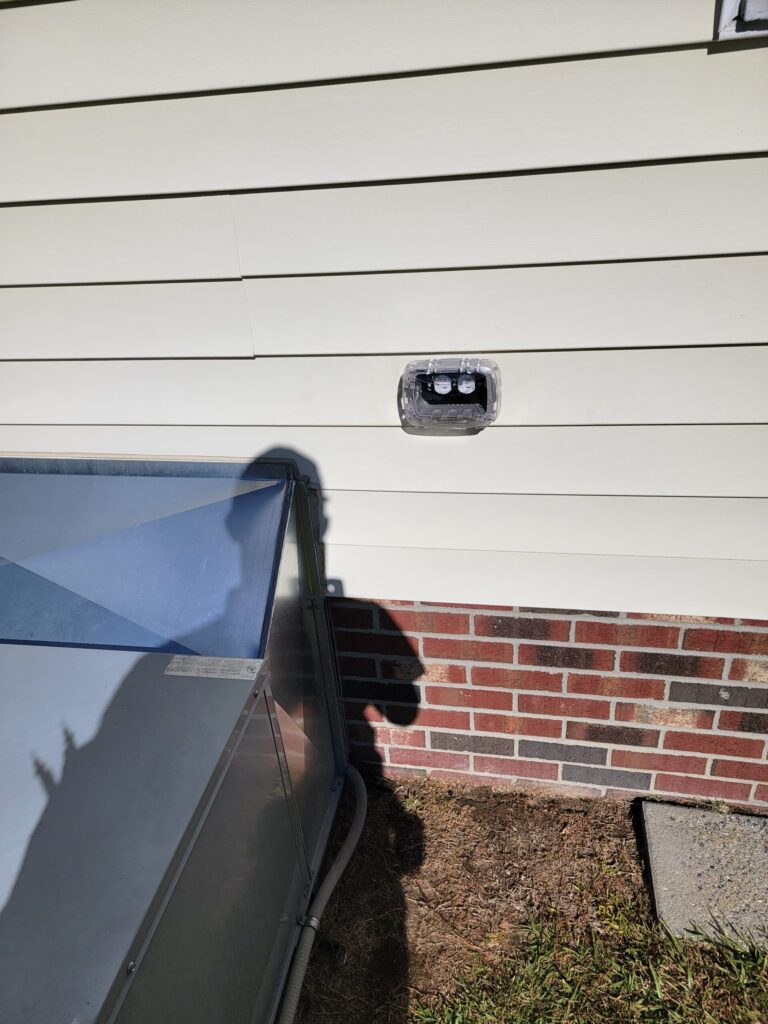
Water and electricity share a home more often in summer than at any other time of year, and the code requirements around pools and spas exist because the consequences of failure are severe. Ground fault circuit interrupter protection is required for pool and spa equipment and for receptacles located near the water, and those devices are designed to open the circuit in a fraction of a second when a small amount of current strays from its intended path. Equipotential bonding is the other half of the protection strategy, and it ties the water, the metal shell of the pool, the ladder, the pump motor, and the surrounding deck reinforcement together so that no dangerous voltage difference can exist between two things a swimmer might touch simultaneously. A hot tub requires a disconnecting means that is within sight of the tub, positioned a safe distance from the water, and readily accessible to anyone who needs to shut it down quickly. These are not optional refinements. They are the difference between a nuisance shock and a fatal one.
The warning signs around pools and spas are easy to dismiss as equipment quirks. A GFCI that trips every time the pump starts, or one that trips after every rainstorm, is reporting a real leakage path rather than being oversensitive. Any tingling sensation felt while entering or exiting the water, or while touching a ladder, rail, or light fixture, should be treated as an emergency without exception, and everyone should exit the water immediately and stay out until the system has been inspected. Corroded conduit fittings, degraded underwater light housings, damaged pump seals, and buried cable damage from landscaping equipment are all common sources. Hot tubs added by previous owners frequently have improvised wiring, missing bonding, or a disconnect placed in the wrong location. Portable spas plugged into a standard receptacle through an adapter are another recurring hazard we find. Adding or correcting spa wiring this summer? Click here for our hot tub wiring service.
Seasonal opening and closing routines also create risk that homeowners rarely anticipate. Enclosures that sat through a New Hampshire winter accumulate moisture, insects, and corrosion, and a weather resistant cover that cracked under ice will no longer keep rain out of a receptacle. Underground feeders can be damaged by frost movement, tree roots, or a shovel during spring landscaping, and that damage may not show up until the circuit sees a full season of load. Timers, pumps, and heaters that were replaced over the years may not match the overcurrent protection that was originally installed for them. A proper inspection at the start of the season checks bonding continuity, GFCI operation, conductor condition, and enclosure integrity before anyone gets in the water. That inspection takes far less time than most people expect. It is one of the highest value services we perform each summer.
Thunderstorms and Power Surges Cause Sudden Electrical Emergencies
Summer thunderstorms in the Lakes Region produce both direct lightning strikes and the far more common indirect surges that travel along utility lines, cable television service, and telephone or fiber entries. A nearby strike does not need to hit your house to damage it, since the electromagnetic energy induced on overhead conductors can drive a voltage spike thousands of times greater than normal service voltage into your panel in microseconds. Utility switching operations, downed lines, and equipment cycling on the grid produce smaller surges throughout the year that most homeowners never notice. Modern homes are more vulnerable than older ones because so many devices contain sensitive electronics, including heat pumps, induction ranges, well pump controllers, garage door openers, security systems, and every smart device in the house. Damage sometimes appears immediately as a dead appliance, and sometimes it accumulates as degraded components that fail weeks later. The financial exposure adds up quickly across an entire house.
Layered surge protection is the accepted approach in the trade. A service entrance device installed at the panel intercepts the large events coming in from outside, and current code now requires surge protection to be installed on dwelling unit services when a service is replaced or newly installed. Point of use protectors at televisions, computers, and audio equipment handle the smaller residual energy that gets past the first layer and provide protection against surges generated inside the home by motor loads. Neither layer replaces the other, and a power strip alone at the entertainment center does nothing for the heat pump or the well pump. Grounding quality matters just as much as the protector itself, because a surge protective device works by diverting energy to ground and can only perform as well as the grounding electrode system allows. Older homes frequently have grounding that was acceptable when installed but no longer meets current requirements. Want to protect the whole house before the next storm? Click here for our whole house surge protection service.
Storm related outages create a second category of emergency that has nothing to do with surges. When the power goes out for an extended period, homeowners reach for portable generators, and improper generator connections cause serious injuries every year. Backfeeding a generator into the house through a dryer receptacle or any other outlet energizes the utility conductors leaving your home and puts line workers at risk while also bypassing every overcurrent protection device in your panel. A properly installed transfer switch or a listed breaker interlock kit isolates your home from the utility and makes the connection safe and simple. Portable units also need to run outdoors, well away from windows and doors, because carbon monoxide from a generator running in a garage or under a deck has killed people who thought the ventilation was adequate. Standby generators eliminate the guesswork entirely by starting automatically and transferring load through a listed switch. Planning that installation before storm season is always easier than arranging it during an outage.
Why You Need an Emergency Electrician Before a Small Problem Spreads
Electrical faults do not stay contained, and the cost of waiting almost always exceeds the cost of the original repair. A loose connection that could have been corrected in a single visit becomes a damaged conductor, then a damaged device, then a section of wiring that has to be replaced from end to end. The most expensive outcome is a fire, and residential electrical fires cause deaths, injuries, and property loss every year in this state alone. Insurance carriers also look closely at the condition of a home’s electrical system after a loss, and unpermitted or improper work complicates claims. An emergency electrician exists for the situations that cannot safely wait for a scheduled appointment, and knowing when to make that call is a skill worth having.
What to Do Before Your Emergency Electrician Arrives
Your first priority is separating people from the hazard. Move everyone away from the affected area, keep children and pets clear, and do not touch anything that feels warm or appears damaged. If you can safely reach your panel and identify the circuit involved, switch that breaker off and leave it off until an electrician has inspected the work. Do not remove the panel cover, and do not attempt to reset a breaker repeatedly in an effort to keep power on. Standing water anywhere near electrical equipment means you should not approach at all.
If you see smoke or flame, get everyone out of the building and call 911 before doing anything else. Never use water on an electrical fire, because water conducts current and turns a contained problem into a direct hazard to you. A properly rated extinguisher is appropriate only for a small fire that you can address without putting yourself between the fire and an exit. If someone is in contact with an energized conductor or device, do not touch them; shut off power at the source if you can reach it safely and call for emergency medical help immediately. Document what you observed so the electrician has an accurate account of the sequence of events.
While you wait, write down the details that will speed up diagnosis. Note which circuits and rooms are affected, what equipment was running when the problem started, how long the symptoms have been occurring, and any work that has been performed in the home recently. Photographs of scorch marks, tripped breakers, or damaged devices are genuinely useful, provided you can take them from a safe distance. Gather any information you have about the age of the home and previous electrical work. Small details often point directly to the cause and save considerable troubleshooting time.
How an Emergency Electrician Finds the Real Cause of an Electrical Failure
A thorough emergency response starts at the service and works inward rather than starting at the symptom. We verify incoming voltage on both legs, check the condition of the service conductors and the meter socket, and confirm that the grounding and bonding system is intact and properly sized. Inside the panel, we look at breaker condition, torque at terminations, evidence of heat at the busbars, conductor sizing against overcurrent protection, and the general condition of the enclosure. That sequence matters because service level problems produce symptoms that show up on individual circuits and would otherwise be misdiagnosed as device failures. Skipping this step is how the same problem returns a month later.
From there, the work moves to the affected circuit using diagnostic tools rather than assumptions. Thermal imaging identifies hot connections behind covers without disturbing them, and it frequently reveals problems on circuits the homeowner never suspected. Insulation resistance testing, voltage drop measurement, and circuit tracing locate faults inside walls with far less demolition than exploratory opening would require. Every device on the run gets inspected, because a fault that appears at one outlet often originates two boxes upstream. We also verify that GFCI and arc fault protection is present where code requires it and that those devices actually function.
The final step is a repair that satisfies the National Electrical Code and the amendments adopted here in New Hampshire, along with clear documentation of what was found and what was corrected. Temporary fixes have a place during a true emergency, but they should always be followed by a permanent correction rather than allowed to become the permanent condition. We explain the cause in plain language, show you the failed components, and lay out any related work the system needs so you can plan rather than react. Permits and inspections are handled where the scope requires them. That paperwork protects you at resale and with your insurance carrier.
Why Choose Whiting Electrical Services for Your Electrical Emergency
Whiting Electrical Services backs the work we perform with a Lifetime Craftsmanship Warranty, which reflects how seriously we take the quality of every connection we make. We hold an A rating with the Better Business Bureau, and we have been trusted by clients including Mr. Beast and WillScot for electrical projects that demanded precision and accountability. As a Generac Certified Dealer and Service Provider, we handle standby generator installation, repair, and maintenance for homeowners who would rather not lose power during the next storm. Our team also offers a 10 percent discount for veterans, first responders, and paramedics as a small thank you for their service. Every job is approached with the same standard, which is a five star service experience from the first phone call to the final walkthrough.
Local experience matters more in this trade than most homeowners realize. We work daily in Laconia, Gilford, Meredith, Belmont, Alton, Wolfeboro, Franklin, Concord, Bow, Pembroke, Loudon, Hopkinton, Plymouth, Farmington, and Wakefield, so we know the housing stock, the common wiring vintages, and the specific ways New Hampshire weather stresses residential electrical systems. That familiarity shortens diagnostic time and produces repairs suited to the conditions your home actually faces. We arrive prepared for the equipment and panel types common in this region. Emergencies rarely happen at convenient hours, and we plan for that.
An electrical emergency is not something to research and revisit later, because the conditions that produce burning smells, hot outlets, arcing, and repeated breaker trips get worse with every hour the circuit stays energized. If your home is showing any of the signs described here, shut off the affected circuit and get a licensed electrician on site to find the cause. Whiting Electrical Services is located at 140 Court St B, Laconia, NH 03246, and our team is ready to respond when your electrical system needs immediate attention. Call us at (603) 512-3887 to speak with someone about your situation, or email Info@whitingelectricalservices.com to schedule an inspection before a small problem becomes a serious one.