
Space Heater Safety and the Outlets That Can Handle Them
New Hampshire mornings start turning sharp long before anyone thinks about firing up the furnace, and that is exactly when portable heaters come out of the attic and get plugged into the nearest outlet. A space heater is one of the highest draw appliances a homeowner will ever plug into a standard wall receptacle, and most people plug one in without ever thinking about what is behind that faceplate. Fire investigators consistently connect portable heaters to the majority of home heating fire deaths in the United States, and the failure point is very often the outlet, the cord, or the circuit rather than the heater itself. A typical 1,500 watt heater pulls roughly 12.5 amps at 120 volts, which means it can occupy nearly an entire branch circuit on its own for hours at a time. Older homes around Laconia, Gilford, Meredith, and Concord frequently have receptacles that were installed decades ago and have never been tested under that kind of sustained load. The good news is that the electrical side of space heater safety is straightforward once you understand amp ratings, continuous load rules, and the warning signs a struggling outlet gives off. This guide walks through which outlets can genuinely handle a portable heater, which ones cannot, and what to do about the ones that fall short before the cold season arrives in full.
How Space Heater Safety Depends on the Outlet and Circuit Behind It
Space heater safety is a wiring question far more than it is an appliance question, because the heater simply asks for current and the circuit either delivers it safely or degrades while trying. Every branch circuit in your home has a conductor size, a breaker rating, and a series of connections at each device along the way, and a portable heater tests all three at once for hours on end. The National Electrical Code treats any load running three hours or longer as a continuous load, and continuous loads are limited to 80 percent of the circuit rating. That single rule is the reason a 1,500 watt heater and a 15 amp circuit are a poor match, even though the breaker may never trip. Heat builds slowly at loose terminations, worn receptacle contacts, and undersized cords, and the damage accumulates across an entire winter rather than showing up in one dramatic moment. Understanding what your outlet is actually rated for is the first real step toward using a portable heater without risking your home.
Space Heater Safety Starts With the Amp Rating of the Outlet Circuit
Standard 120 volt receptacle circuits in a home are wired at either 15 amps using 14 gauge copper conductors or 20 amps using 12 gauge copper conductors, and that difference matters enormously when a heater is involved. Applying the continuous load rule, a 15 amp circuit can safely carry 12 amps for hours, while a 20 amp circuit can safely carry 16 amps for hours. A 1,500 watt heater pulling approximately 12.5 amps therefore exceeds the safe continuous capacity of a 15 amp circuit before you add a single lamp, phone charger, or television to the same run. Many homeowners assume that a breaker holding steady means everything is fine, but breakers are designed to protect the wiring from catastrophic overload rather than to police a load sitting right at the edge of capacity. A circuit that runs at or slightly above its continuous rating for eight hours a night will get warm at every splice, every backstab connection, and every terminal screw that was not torqued properly at installation. That heat is the real hazard, and it is completely invisible until something discolors or fails.
Knowing which circuit an outlet belongs to is just as important as knowing its rating, because most bedroom and living room circuits in New Hampshire homes serve multiple rooms at once. A single 15 amp circuit might feed two bedrooms, a hallway, several lighting outlets, and a handful of receptacles, all sharing the same 12 amp continuous ceiling. Add a portable heater to that circuit and you have already committed the entire safe capacity to one appliance, leaving nothing for the vacuum, the window air conditioner in shoulder season, or the television. You can identify circuit boundaries by turning off one breaker at a time and walking the house with a lamp or a receptacle tester, and it is worth writing the results directly onto the panel directory. Homeowners in older Laconia and Franklin houses are often surprised to learn how many devices sit on a single overworked circuit. Once you see the actual layout, the case for a dedicated circuit becomes obvious rather than theoretical.
The receptacle face itself gives you a clue about the circuit, though it is not a guarantee. A standard 15 amp receptacle has two parallel vertical slots plus a ground, while a 20 amp receptacle has a small horizontal notch branching off the neutral slot to form a T shape. Code does permit 15 amp receptacles on a 20 amp circuit when multiple receptacles are present, so a plain receptacle face does not automatically mean 15 amp wiring behind it. The only reliable confirmation comes from tracing the circuit to the breaker and verifying the conductor gauge at the panel, which is work best handled by a licensed electrician rather than guessed at from the living room. If your panel directory is missing, illegible, or clearly inaccurate from past remodels, that is a strong signal that a full circuit mapping is overdue. Need to know what your outlets and circuits are actually rated for? Click here for our electrical inspection service.
Space Heater Safety Warning Signs at the Outlet Itself
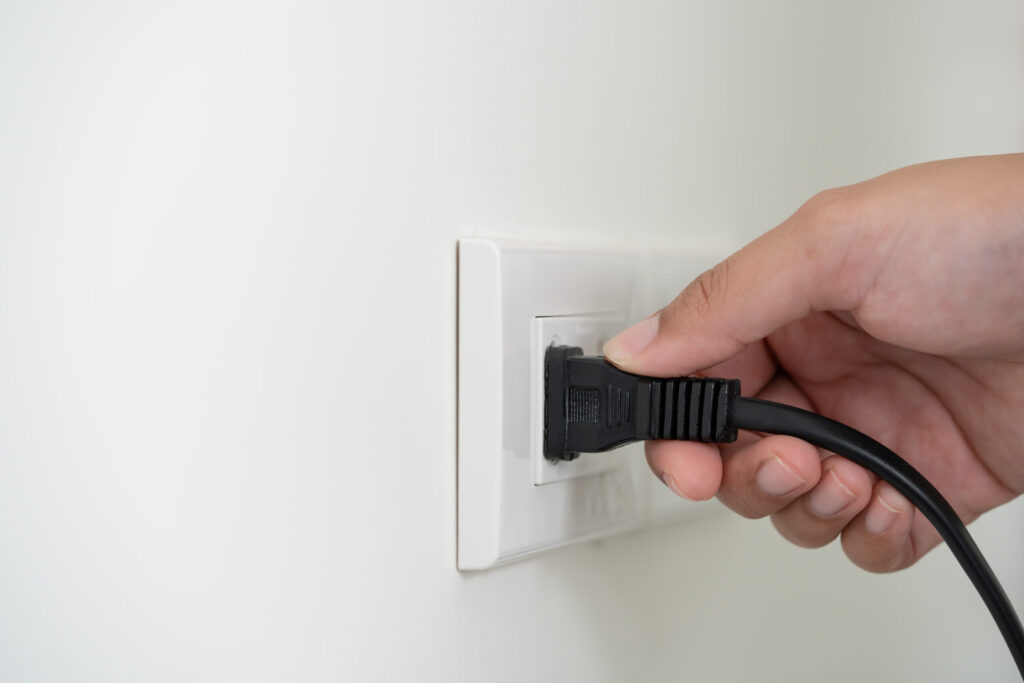
An outlet under stress from a portable heater almost always announces the problem before it fails, and homeowners who know the signals can catch trouble early. Warmth at the faceplate is the most common early indicator, and a receptacle that feels noticeably warm to the touch after an hour of heater use is telling you that resistance is building somewhere in the connection. Discoloration around the slots, a yellowed or browned plastic face, or a faint plastic odor near the outlet all point to heat that has already begun to degrade the device. A plug that feels loose in the receptacle is another serious signal, because the internal contacts have lost spring tension and are now touching the plug blades across a smaller surface area than they should. Less contact area means more resistance, more resistance means more heat, and more heat further weakens the contacts in a cycle that accelerates over time. Any buzzing, crackling, or intermittent flicker when the heater cycles on deserves immediate attention rather than a wait and see approach.
Older receptacles frequently fail for reasons that have nothing to do with the heater and everything to do with how they were installed. Backstab connections, where the conductor is pushed into a spring loaded hole on the back of the device rather than wrapped around a screw terminal, are legal on 15 amp devices but rely on a small spring for a connection that must carry current for decades. Under a sustained 12 amp load those connections loosen, oxidize, and arc, and that arcing generates heat inside a plastic box packed with insulation and wire. Homes built roughly between 1965 and 1973 may also contain aluminum branch circuit wiring, which expands and contracts more than copper and requires approved connectors such as COPALUM or AlumiConn at every termination. Aluminum branch circuits and portable heaters are a genuinely dangerous combination, and no amount of careful heater placement compensates for a connection that is quietly working itself loose. If you have any reason to suspect aluminum wiring, that finding alone warrants a professional evaluation before heater season begins.
The right response to a warm or discolored outlet is to stop using it for the heater immediately and get the device replaced rather than simply moving the heater to the next room. Replacing a receptacle takes an electrician a matter of minutes, but the value of the visit comes from what happens during the swap, when the conductors, the box fill, the terminations, and the grounding can all be verified at the same time. A receptacle that has overheated once has usually damaged the conductor insulation directly behind it, so a straight device replacement without inspecting the wire is an incomplete repair. Electricians also check the neighboring outlets on the same circuit, since a loose connection upstream can heat a downstream device that looks perfectly normal on its own. Repairs like this are inexpensive compared to the alternative and they permanently remove a hazard from your home. Seeing warm or discolored outlets in your home? Click here for our electrical repair service.
Space Heater Safety Rules for Extension Cords and Power Strips
Nearly every portable heater manufacturer prints the same instruction on the unit and in the manual, which is to plug the heater directly into a wall receptacle and never into an extension cord or power strip. That instruction exists because extension cords are built for intermittent use with modest loads, and a heater represents the opposite of both conditions. A light duty cord using 16 or 18 gauge conductors carrying 12.5 amps for hours will heat along its entire length, and the heat is worst where the cord is coiled, tucked under a rug, or pinched behind furniture. Voltage drop compounds the problem on longer runs, causing the heater to draw slightly more current to compensate while the cord itself dissipates the difference as heat. The failure mode is not a tripped breaker but a melted jacket, a scorched carpet, or an ignition source sitting under something combustible. This is one rule that has no reasonable exception in a residential setting.
Power strips and surge protectors deserve their own warning, because they look sturdier than a cord and give homeowners false confidence. Most residential power strips use internal conductors and switch contacts rated for the strip as a whole rather than for a single sustained 12.5 amp load on one outlet. The switch contacts and internal solder joints represent additional resistance points, and each one becomes a heat source under continuous heater current. Cube taps and outlet multipliers are worse still, since they add mechanical connections without adding any protective device or thermal management. Some strips include a small circuit breaker, but that breaker protects against gross overload rather than the slow thermal degradation that a heater causes. Plugging a heater into anything other than a properly rated wall receptacle removes the safety margin the electrical system was designed around.
Placement matters alongside the connection, and the standard clearance guidance is three feet of open space between the heater and anything that can burn. Curtains, bedding, upholstered furniture, laundry piles, cardboard boxes, and stacks of paper all belong outside that perimeter, and the heater should always sit on a hard level floor rather than on carpet, a rug, or a piece of furniture. Choose units that carry a listing from a recognized testing laboratory and that include both a tip over switch and an overheat cutoff, since those two features address the most common failure scenarios. Turn the heater off when you leave the room and when you go to sleep, and never use a portable unit to warm a room continuously as a substitute for permanent heat. Bathrooms present a special case, since anything plugged in near a tub or sink must be on a GFCI protected receptacle and should be rated for damp locations. Following placement rules and outlet rules together is what actually makes a portable heater safe.
Which Outlets Can Handle a Space Heater in a New Hampshire Home
Not every outlet in a house is equal, and the differences between them determine which ones can support a portable heater through a full New Hampshire winter without trouble. A newer receptacle on a dedicated 20 amp circuit with solid screw terminal connections and proper grounding is a genuinely good match for a 1,500 watt heater. A 1970s receptacle on a shared 15 amp circuit in a house with a fuse panel is a poor match no matter how new the heater is. Kitchens, garages, basements, and bathrooms each carry their own code requirements for GFCI protection, and living areas and bedrooms carry requirements for arc fault protection. Homes in Alton, Belmont, Wolfeboro, and Plymouth range from recent construction to structures well over a century old, and the wiring inside them varies just as widely. Knowing which category your outlets fall into tells you exactly where a heater can go and where it should never be plugged in.
Outlets That Can Handle a Space Heater on a Dedicated 20 Amp Circuit
The best outlet for a portable heater is one on a dedicated 20 amp circuit that serves nothing else, because that arrangement gives the heater 16 amps of continuous capacity against a 12.5 amp draw. That margin absorbs the inrush when the heating element and fan start, tolerates the small variations in current that come with voltage fluctuation, and keeps every connection along the run operating well below its thermal limit. A dedicated circuit also eliminates the guesswork about what else is sharing the load, so nobody has to remember not to run the vacuum in the same room. Twelve gauge copper conductors carry the current with less voltage drop than 14 gauge, which keeps the heater operating at its rated output rather than slightly below it. For homeowners who rely on a portable heater in a home office, a finished basement, a workshop, or a bonus room over a garage, a dedicated circuit is the single most effective upgrade available. The cost is modest when the space is accessible and the panel has room for another breaker.
Adding a dedicated circuit involves running new cable from the panel to the room, installing a properly rated breaker, and terminating a new receptacle on screw terminals with a verified equipment grounding conductor. The work also requires confirming that the existing panel has both physical space and adequate service capacity for the addition, which is where many older New Hampshire homes run into limits. A 100 amp service that already carries electric water heating, a well pump, a range, and a dryer may not have comfortable room for additional heating loads. In those cases the correct answer is a service evaluation rather than squeezing another breaker into a crowded panel. Electricians also look at the panel type during this work, since certain legacy panels have known reliability problems and should be replaced rather than expanded. Doing this work before winter avoids the scramble that happens the first week temperatures drop.
There is also a durable alternative worth considering for rooms that need heat every winter, which is permanently installed electric heat instead of a portable unit. Electric baseboard heaters, wall heaters, and cove heaters are typically wired at 240 volts on their own dedicated circuits with a wall thermostat, and they remove the cord, the plug, and the receptacle from the equation entirely. Permanent units have no tip over risk, no cord to pinch, and no plug connection to loosen over the years, which addresses most of the failure modes that make portable heaters dangerous. They also deliver heat more evenly across a room rather than concentrating it in one corner. The tradeoff is installation cost and the need for adequate service capacity, which is why the panel evaluation happens first. Need a dedicated circuit for a heater or a new appliance? Click here for our electrical wiring service.
Older Outlets That Cannot Handle a Space Heater Safely
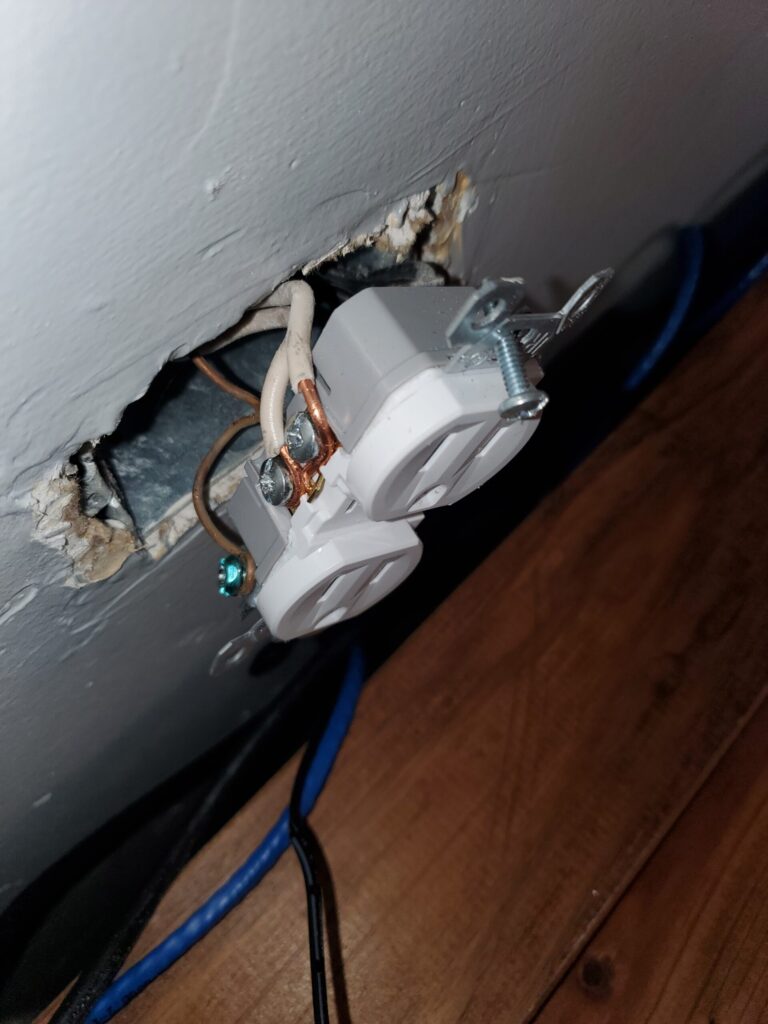
Two prong ungrounded receptacles are the clearest example of an outlet that cannot handle a portable heater, and they remain common in New Hampshire homes built before the 1960s. Without an equipment grounding conductor there is no low resistance path to clear a fault, which means a ground fault inside the heater or the cord may energize the metal chassis instead of tripping the breaker. Many homeowners work around this with a cheater adapter that converts a three prong plug to two prongs, which defeats the ground connection entirely and creates exactly the hazard the third prong was designed to prevent. Others replace a two prong device with a three prong device without running a ground, producing an outlet that looks safe and tests as a false ground. Neither approach is acceptable, and both are common enough that testing every receptacle in an older home is worthwhile. The correct remedies are running a proper grounding conductor, rewiring the circuit, or installing GFCI protection with the required labeling.
Knob and tube wiring presents an even more serious limitation, and it still exists in portions of many older homes throughout Belknap and Merrimack counties. The system uses individual conductors run through ceramic knobs and tubes with no grounding conductor and with rubber or cloth insulation that becomes brittle after decades of thermal cycling. Knob and tube was designed to dissipate heat through open air, so any section buried in blown insulation from a later energy retrofit is operating in conditions the system was never intended to handle. Adding a 12.5 amp continuous heater load to that kind of circuit is a genuine fire risk rather than a theoretical one. Insurance carriers often flag knob and tube during underwriting for the same reason. Homes with any remaining knob and tube should have those circuits replaced before portable heaters enter the picture at all.
Fuse panels and undersized services round out the list of situations where a portable heater should not be used casually. A 60 amp service with a fuse panel was sized for an era of far lighter electrical demand, and homeowners frequently deal with repeated blown fuses by installing a larger fuse than the wiring is rated to carry. That practice removes the overcurrent protection from the circuit and allows conductors to overheat inside walls with no warning at all. Certain legacy breaker panels also have documented histories of breakers failing to trip under fault conditions, and adding sustained heating loads to those panels compounds an existing problem. If your home still has a fuse panel, a 60 amp service, or a panel brand with known defects, that is the item to address first. Considering a service upgrade before winter? Click here for our electrical service upgrade page.
GFCI and AFCI Outlets That Can Handle a Space Heater in Wet or Finished Spaces
GFCI protection is required by code in bathrooms, kitchens, garages, unfinished basements, laundry areas, crawl spaces, and outdoor locations, and those requirements apply to any receptacle a heater might use in those spaces. A GFCI device monitors the current leaving on the hot conductor against the current returning on the neutral and opens the circuit within milliseconds when the difference indicates current is escaping through an unintended path. That protection matters enormously in basements and garages where concrete floors, moisture, and metal equipment create better paths to ground than dry finished rooms do. A portable heater used in a workshop or a finished basement should always be on a GFCI protected circuit for exactly that reason. Test buttons should be exercised monthly, and a device that fails to trip or fails to reset needs replacement rather than continued use. GFCI devices also have a service life, and units installed twenty years ago often no longer trip reliably.
Repeated GFCI trips when a heater is running deserve investigation rather than frustration. Heating elements can develop small amounts of leakage current as they age, particularly in units stored in damp basements or garages where moisture collects inside the housing. Damaged cords, worn plug blades, and moisture inside the receptacle box can all produce the same result. The one response that is never acceptable is moving the heater to a circuit without GFCI protection in order to stop the tripping, because the device was doing its job and the underlying fault remains. An electrician can determine quickly if the fault originates in the heater, the cord, the receptacle, or the branch circuit wiring. Need GFCI protection added in a basement, garage, or bathroom? Click here for our GFCI outlet installation service.
Arc fault protection addresses a different hazard and is required in bedrooms, living rooms, family rooms, hallways, kitchens, and most other dwelling unit areas under current code. An AFCI device recognizes the electrical signature of arcing at damaged conductors, loose terminations, and failing devices, then opens the circuit before that arcing ignites nearby materials. Since loose connections and worn receptacle contacts are precisely the failure modes a portable heater tends to expose, arc fault protection is directly relevant to heater season. Older homes rarely have AFCI protection anywhere, and adding it usually means installing combination type breakers at the panel during a panel upgrade or a targeted circuit improvement. Tamper resistant receptacles are also required in dwelling units now, which matters in any home with young children who might explore an outlet near a heater. Bringing outlets and protection up to current standards makes portable heater use dramatically safer across the whole house.
Why You Need an Electrician Before Space Heater Season in New Hampshire
Late summer and early fall are the ideal window for this work, since the weather is mild, schedules are open, and nothing has to be rushed while temperatures drop. Once October arrives in the Lakes Region, heaters come out of storage and get plugged into whatever outlet is closest, which is exactly when overloaded circuits and worn receptacles begin to fail. An electrician can map your circuits, verify conductor sizes, test grounding and polarity at every receptacle, and identify the outlets that are actually suitable for a portable heater. That same visit is the natural time to address any aluminum wiring, missing grounds, failing GFCI devices, or panel capacity limits that would create problems later. Homeowners who handle this before the cold season spend the winter without worrying about which outlet the heater is using. Planning ahead is far less expensive than an emergency call on the coldest night of the year.
Why You Need an Electrical Inspection Before Space Heater Season
A thorough electrical inspection gives you a complete picture of what your home can safely support rather than a guess based on what has worked so far. The electrician tests each receptacle for correct polarity, verified grounding, and proper operation, then evaluates the panel for capacity, breaker condition, and available space. Circuits get traced and labeled so you know exactly what shares a run with the room where the heater will sit. Any device showing heat damage, loose terminations, or backstab connections carrying heavy loads gets flagged for correction. The result is a clear list of what is safe today and what needs attention before winter.
Inspections also catch problems that have nothing to do with heaters but everything to do with home safety. Double tapped breakers, missing cable clamps, open junction boxes, undersized conductors from past do it yourself work, and improperly bonded panels all show up regularly in homes across the Lakes Region. Insurance carriers and home buyers ask about these items, and correcting them ahead of time removes friction from any future transaction. For homeowners who have recently bought an older property, an inspection is the fastest way to understand what you actually own. It converts uncertainty into a specific plan with real costs attached.
The timing advantage of an early inspection is substantial. Scheduling in late summer means any recommended work gets completed on a normal timeline, with parts ordered and permits handled without pressure. Waiting until the first cold snap means competing with everyone else who waited, and it means making decisions quickly instead of carefully. Small corrections found early stay small, while the same issues discovered in January after a failure often involve damaged wiring and repairs to finishes. An inspection in August or September is the least expensive version of this conversation you will ever have.
Why You Need Upgraded Outlets and Circuits Before Space Heater Season
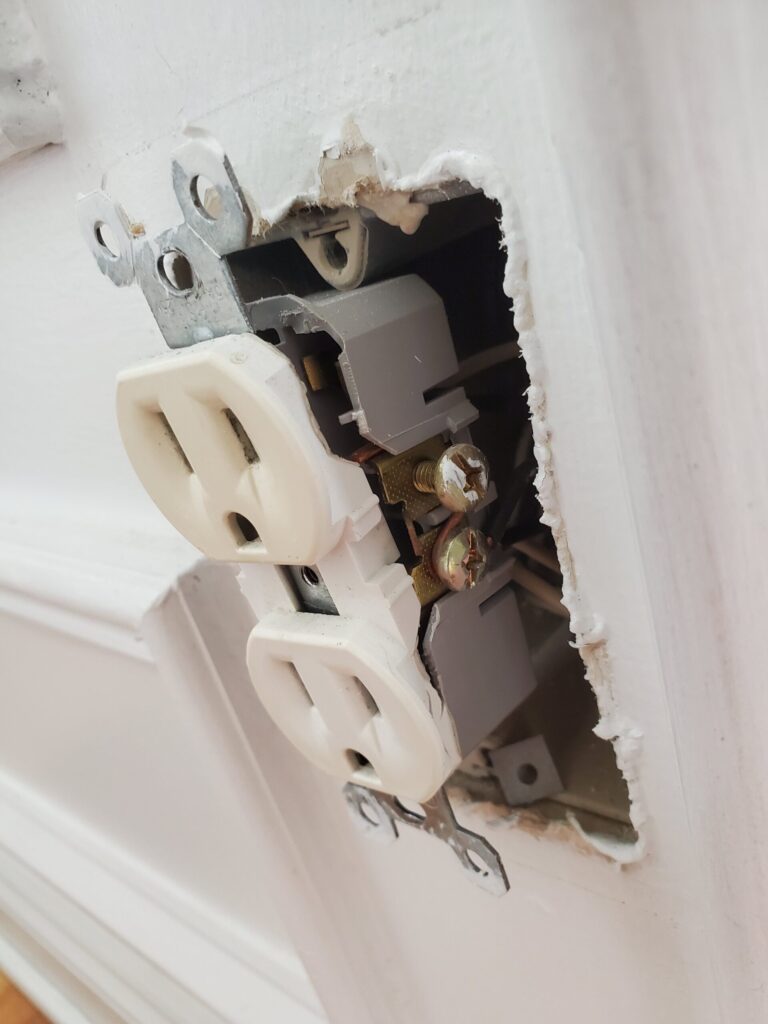
Upgrading outlets is often simpler and less expensive than homeowners expect, particularly when the existing wiring is sound and only the devices need replacement. Swapping worn receptacles for new ones with screw terminal connections restores proper contact pressure and removes the resistance points that generate heat. Adding tamper resistant devices, GFCI protection, and correct grounding brings older rooms in line with current standards. In rooms where a heater will be used regularly, adding a dedicated 20 amp circuit removes the load sharing problem permanently. Each of these improvements pays for itself in reduced risk over a single winter.
Panel work is the other half of the equation, since new circuits require both physical space and adequate service capacity. Many New Hampshire homes still operate on 100 amp services that were sized before electric vehicles, heat pumps, and home offices existed. Upgrading to a 200 amp service creates room for heating circuits, generator connections, and future additions without forcing tradeoffs each time something new gets added. Subpanels can also solve the problem efficiently for detached garages, workshops, and finished basements. An electrician can tell you quickly which approach fits your house and your plans.
Whole house surge protection deserves mention as part of the same conversation, especially in homes with sensitive electronics and modern appliances. New Hampshire winters bring utility switching events, ice related outages, and restoration surges that reach every circuit in a house. A surge protective device installed at the panel absorbs those transients before they travel to the equipment plugged in downstream. Combining a panel upgrade with surge protection is efficient because both involve the same access and the same visit. Handling everything at once minimizes disruption and cost.
Why Choose Whiting Electrical Services Before Space Heater Season
Whiting Electrical Services works throughout the Lakes Region and central New Hampshire from our location at 140 Court St B in Laconia, serving homeowners in Gilford, Meredith, Belmont, Alton, Franklin, Concord, Bow, Loudon, Hopkinton, Pembroke, Plymouth, Wolfeboro, Wakefield, and Farmington. We back our work with a Lifetime Craftsmanship Warranty, we maintain an A rating with the Better Business Bureau, and we are a Generac Certified Dealer and Service Provider for homeowners who want backup power alongside their electrical improvements. Our team has been trusted by organizations including Mr. Beast and WillScot for electrical projects, and we bring that same standard to a single receptacle replacement in a Laconia bedroom. We offer a 10 percent discount for veterans, first responders, and paramedics as a small thank you for their service. Every job is approached with the goal of delivering five star service the first time.
What sets our approach apart is that we look at the whole system rather than only the item you called about. A warm outlet gets traced back to its circuit, its terminations, and its breaker, because replacing a device without finding the cause simply moves the problem down the line. We explain what we find in plain language, show you the condition of your wiring, and give you clear options with real numbers attached. You decide what gets done and when, with no pressure and no vague estimates. That transparency is why our customers call us back for the next project.
Getting your outlets and circuits ready now means you can use a portable heater this winter without wondering what is happening behind the faceplate. We can inspect your receptacles, add dedicated circuits, install GFCI and arc fault protection, evaluate your panel, and handle service upgrades before the first cold week arrives. Scheduling in late summer keeps the work unhurried and the pricing predictable. Reach out to our team at (603) 512-3887 or email Info@whitingelectricalservices.com to book an evaluation, and let us make sure the outlets in your home can genuinely handle the load you are about to put on them.