



Can You Install a Hot Tub Without a Dedicated Circuit?
The decision to add a hot tub to your home is an exciting one. It is an investment in relaxation and wellness, a promise of tranquil evenings spent soaking under the stars. As you plan for the delivery of your new spa, you will focus on finding the perfect spot in your yard and getting the foundation ready. But one of the most critical questions you will face is: how will you power it? It is a common and understandable question for a new owner to ask. You see the large electrical cord and wonder if you can simply plug it into your existing outdoor outlet.
For any standard 240-volt hot tub, the answer to that question is a firm, unequivocal no. A hot tub is a powerful, high-demand appliance that absolutely requires its own dedicated circuit, professionally installed by a licensed electrician. Attempting to power a hot tub in any other way is not only impractical and against all electrical codes, but it is also extremely dangerous, posing a significant risk of fire and electric shock. The professional installation of a dedicated circuit is not an optional add-on; it is an essential and non-negotiable part of owning a hot tub safely.
Understanding the Immense Power Demand of a Hot Tub
To appreciate why a dedicated circuit is so essential, it is important to understand the sheer amount of electrical power a modern hot tub consumes. This is not a simple appliance. It is a complex piece of equipment with multiple, power-hungry components that often need to run simultaneously. The primary components are a powerful water pump, or in many cases, multiple pumps to power the jets, and a high-wattage electric heater that is responsible for bringing hundreds of gallons of water up to temperature and keeping it there. On top of that, there are often circulation pumps, blowers, LED lights, and even stereo systems.
When the heater and the pumps are running, a standard hot tub can require a 50-amp or even a 60-amp, 240-volt circuit to operate safely. To put that into perspective, a typical household circuit that powers the outlets in your bedroom or living room is only 15 amps at 120 volts. A hot tub can draw more power than a central air conditioner, an electric range, and a clothes dryer combined. It is one of the single largest electrical loads in a modern home.

The small exception to this rule is the category of “plug-and-play” hot tubs. These are typically smaller, entry-level models that are designed to plug into a standard 120-volt outlet. However, even these come with major compromises. Their heaters are far less powerful and often cannot run at the same time as the jets. Even for these models, the manufacturer will almost always require that they be plugged into a dedicated outlet that does not share its power with any other devices.
Considering purchasing a hot tub? Click here to learn more about the electric behind it.
The Dangers of an Improperly Powered Hot Tub
Attempting to run a 240-volt hot tub on an existing, standard household circuit is a recipe for disaster. The immense power draw would cause the circuit breaker to trip instantly and constantly. The real danger arises if someone, in an attempt to solve this problem, makes the catastrophic mistake of installing a larger breaker on that existing, undersized circuit.
The circuit breaker in your panel is a safety device that is specifically sized to protect the gauge of the wire inside your walls. A 15-amp breaker is paired with a wire that can only handle 15 amps of current. If you were to put a 50-amp breaker on that circuit to run a hot tub, you would be allowing 50 amps of current to flow through a wire that is only rated for 15. The wire inside your wall would quickly overheat, melt its protective insulation, and almost certainly ignite the surrounding wood framing, causing a devastating house fire.
Beyond the extreme fire risk, an inadequate power supply can also cause serious damage to the hot tub’s sensitive and expensive electronic components. Inconsistent voltage and frequent power trips can ruin the control board, the heater, and the pumps, which would be a costly repair that would not be covered by the manufacturer’s warranty.
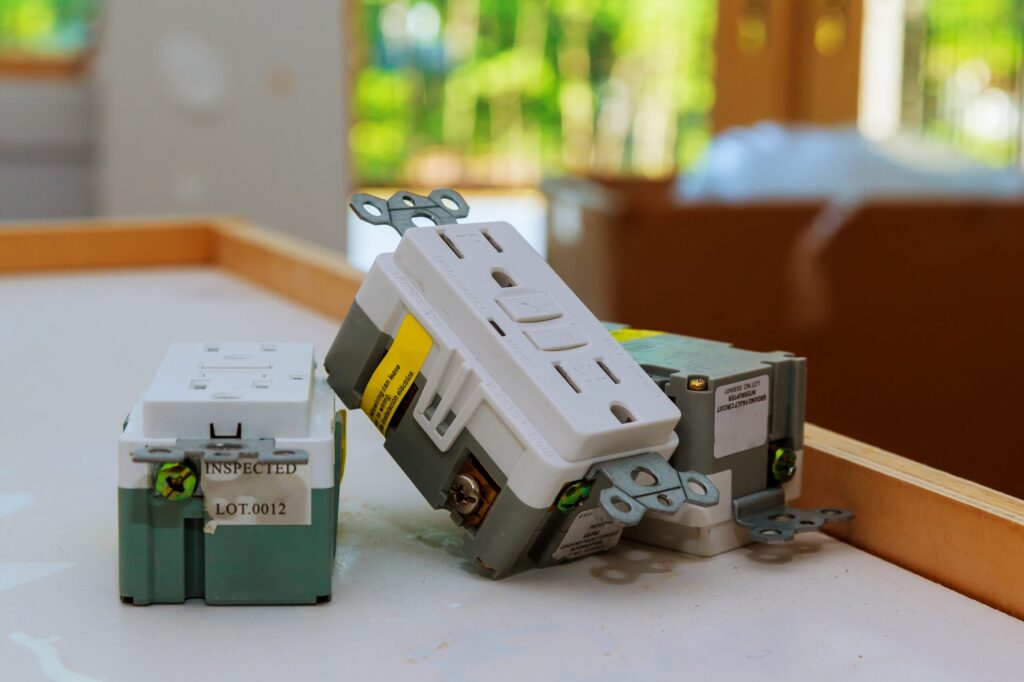
Most importantly, a proper hot tub installation requires a specific life-saving device: a Ground Fault Circuit Interrupter, or GFCI. The National Electrical Code mandates that all hot tubs be protected by a GFCI. This device constantly monitors the flow of electricity and, if it detects even the tiniest leak of current, which could indicate a fault that could energize the water, it shuts the power off in a fraction of a second, preventing a fatal electric shock. A professionally installed dedicated circuit for a hot tub will always include this critical GFCI protection.
Need some GFCI outlets installed? Click here.
What Is a Dedicated Circuit?
A dedicated circuit is essentially a private, express lane of power that runs directly from your main electrical panel to a single, specific appliance. It ensures that a high-power appliance, like your new hot tub, has all the power it needs to operate safely and efficiently, without ever having to share its capacity with any other lights, outlets, or devices in your home.
The installation of a dedicated circuit for a hot tub is a specific and standardized process for a licensed electrician. It begins at your main service panel, where the electrician will install a new, appropriately sized double-pole circuit breaker. For a hot tub, this will be a special GFCI breaker, providing the essential protection right at the source.
From this breaker, the electrician will run a new, heavy-gauge electrical cable to the location of the hot tub. The size of this wire is crucial and is determined by the amperage of the circuit and the distance of the run. Finally, the code requires the installation of a manual disconnect switch in a weatherproof enclosure, which must be located at least five feet away from the hot tub but within your line of sight. This provides a quick and accessible way to shut off all power to the hot tub for safety during maintenance. The new circuit is then safely connected to the hot tub’s internal control panel.
The Professional Installation Process
The installation of a hot tub circuit is a complex job that should only ever be performed by a qualified, licensed, and insured electrical contractor. An expert from Whiting Electrical Services will follow a professional process to ensure your installation is safe, reliable, and fully code-compliant.


The process begins with a thorough assessment of your home’s existing electrical system. The electrician will inspect your main service panel to confirm that it has the available physical space to accommodate a new, large double-pole breaker. They will also perform a load calculation to ensure that your home’s main service has enough overall capacity to handle the significant new load of the hot tub without being overloaded. In some older homes, a service panel upgrade may be necessary before a hot tub can be safely installed.
Once the assessment is complete, the electrician will perform the full installation. This includes installing the new GFCI breaker in the panel, carefully running the new heavy-gauge wiring from the panel to the hot tub’s location, and installing the required outdoor disconnect switch. They will then make the final, waterproof connection to the spa itself. This type of installation requires a permit from the city of Greenville or Pitt County, and the work must be inspected by a local authority to ensure it meets all the safety standards of the National Electrical Code. A professional contractor will handle this entire permitting and inspection process for you.
Your new hot tub is a wonderful investment in your home and your well-being, and its safe and reliable operation depends entirely on the quality of its electrical supply. The answer to the question of whether it can be installed without a dedicated circuit is not just a “no,” it is an “absolutely not.” The immense power demand creates a severe fire risk on a standard circuit, it can cause irreparable damage to the hot tub’s expensive components, and it bypasses the life-saving GFCI protection that is required by law for your family’s safety.
The professional installation of a dedicated circuit should be considered an essential and non-negotiable part of your hot tub purchase itself. If you are a new or prospective hot tub owner in the Greenville, North Carolina area, we encourage you to protect your home, your family, and your new investment. Contact the licensed and insured experts at Whiting Electrical Services for a safe, professional, and fully code-compliant installation of your home charging station.